
STARFLEET LIBRARY COMPUTER · FEDERATION GOVERNMENT · 2371
United Federation of Planets
Federal government, member worlds, civic institutions and interstellar relations
The United Federation of Planets (UFP) is a constitutional interstellar union of sovereign member worlds joined by a common Charter and shared commitments to peaceful cooperation, fundamental rights, exploration, scientific advancement and collective security.
Established on Earth in 2161 by Earth, Vulcan, Andoria and Tellar, the Federation has developed into one of the principal powers of the Alpha and Beta Quadrants. Its institutions provide a common framework for diplomacy and interstellar law while member societies retain their own cultural traditions and domestic systems of government.
Federation Starfleet undertakes exploration, science, humanitarian assistance, diplomacy and defence under the Federation's civilian authority. Starfleet is not itself the Federation government.

Founding and historical development


Cooperation among the eventual founding members intensified during the Babel Crisis of 2154, when Earth, Vulcan, Andorian and Tellarite forces confronted a hostile Romulan drone vessel. Diplomatic discussions led to the development of the Coalition of Planets, a precursor to the Federation. The subsequent Earth–Romulan War (2156–2160) reinforced the need for shared security arrangements.
In 2161, the four powers ratified the Federation Charter in San Francisco. The founding created a durable union rather than a military alliance alone: new common institutions were established to coordinate government, exploration, diplomacy and the protection of rights.
Over the following two centuries the Federation grew through voluntary accession, the settlement and development of colonies, and extensive peaceful contact with neighbouring civilisations. The Federation has nevertheless faced armed conflict, political disputes and threats requiring collective defence.
Government and institutions
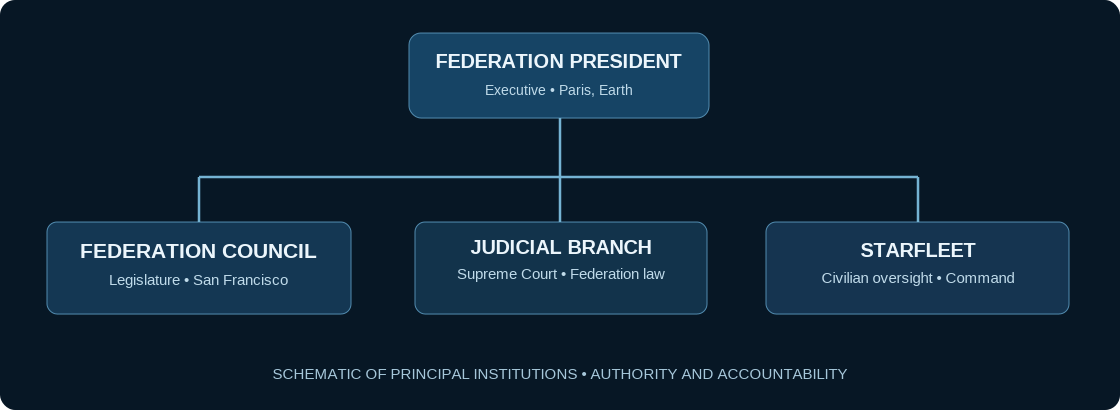
Federation President
The President is the chief executive and serves as both head of state and head of government. The office conducts executive administration and major foreign-policy business, with substantial responsibility for security and the deployment of Starfleet forces. The presidential office is located in Paris, Earth.
Federation Council
The Council is the Federation's central legislative body, composed of representatives of its member worlds. It deliberates on federal legislation, membership, interstellar policy and significant matters affecting Starfleet. Its chamber is located in San Francisco, Earth.
Federation Supreme Court
The Supreme Court represents the Federation's highest judicial institution. Federal law, constitutional guarantees and judicial review exist alongside the distinct legal practices of individual member governments.
Member-world governments
Each member world retains substantial responsibility for internal affairs and cultural governance. Membership requires compliance with Federation principles; accession does not erase a planet's independent historical and political identity.
Administrative distinction: The Federation President, Federation Council and Starfleet Command are separate offices. Military rank does not grant authority to amend Federation civil law or supersede civilian institutions at will.
Charter, Constitution and law
The Federation Charter was ratified by the founding member worlds in 2161 and established the common political union. The Federation Constitution provides foundational legal principles and guarantees. The precise relationship among individual constitutional provisions, federal regulations and member-world legal systems depends on the relevant jurisdiction.
Federation jurisprudence places considerable importance on individual liberty, due process, equality before the law and protections against discrimination. Among the express constitutional protections is the Seventh Guarantee, which safeguards against compelled self-incrimination. A right of due process also informs Starfleet legal proceedings; officers are subject to service regulations and the Federation Uniform Code of Justice.
The Prime Directive is a Starfleet principle governing interference with developing societies. It is not a general authorisation to disregard Federation law, nor does Starfleet service permit officers to intervene in the domestic politics of independent worlds without lawful authority.
Federal responsibilities
Diplomatic relations, common interstellar obligations, admission of new members, Federation-wide rights and the oversight of Starfleet.
Local responsibilities
Many domestic matters, cultural institutions and internal government practices remain with individual member worlds, consistent with federal guarantees.
Membership and accession
Member worlds join the Federation voluntarily. Admission requires formal consideration of the candidate's government and society, including whether the applicant upholds the Federation's principles of lawful governance, rights and peaceful coexistence. Conditions can require substantial political or social reform before accession is approved.
The founding worlds remain important centres of government, education and scientific study. Other well-established member societies include Betazed and Trill; the Federation also encompasses numerous colonies and inhabited systems. Published tallies vary by date and definition; this record does not claim a definitive census of member planets for 2371.
| Earth | Human homeworld; major centre for the Federation Council, President and Starfleet Command. |
|---|---|
| Vulcan | Founding world noted for its scientific and philosophical traditions. |
| Andoria | Founding world with a long tradition of diplomacy and military service. |
| Tellar Prime | Founding world renowned for debate, engineering and political engagement. |
| Betazed | Federation member world associated with Betazoid culture and telepathic abilities. |
| Trill | Federation member world with a distinct society incorporating joined and unjoined Trill. |
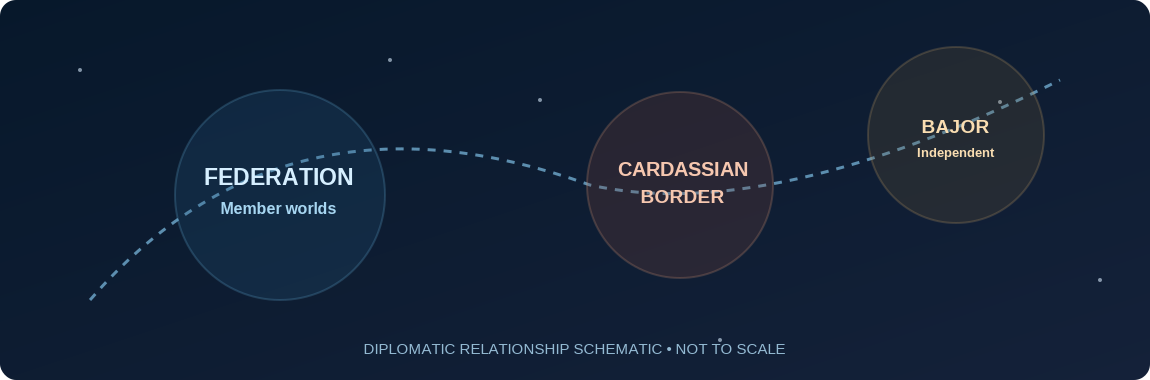
Bajor: The Bajoran Provisional Government administers an independent world cooperating closely with Starfleet and the Federation. Bajor is not a Federation member in 2371. Its prospective accession is a diplomatic question, not an accomplished event.
Society, culture and economy
There is no single Federation culture. Citizens of member worlds retain their languages, customs, beliefs, family structures and traditions. Federation institutions operate across these differences using a commitment to mutual respect, equal civil standing and cooperative public life. Federation Standard is a common administrative language, while universal translators facilitate communication across many species.
Technological capacity has transformed the material conditions of everyday life. Replication, automation, advanced medicine and high-efficiency transportation make many necessities widely accessible. The social and economic conditions of Earth, where material accumulation is no longer the primary measure of individual achievement, should not be assumed identical on every Federation colony or member planet.
Currency and exchange nevertheless remain relevant in Federation dealings with external powers and some internal transactions. Federation credits and other units of account exist; trade, transport capacity, scarce resources and interstellar agreements still require administration. Federation society is therefore not correctly described as a place in which all forms of exchange have ceased.
Education and service
Member societies maintain educational institutions and vocational systems. Starfleet Academy offers one avenue into a career of exploration, scientific inquiry, diplomacy and service.
Health and welfare
Advanced diagnosis, preventive medicine, regenerative treatment and extensive medical infrastructure have greatly improved the response to disease, injury and environmental hazards.
Travel and communication
Subspace networks, starship transport and established trade routes link many member systems; remote frontiers may experience greater communication delays and logistical difficulties.
Cultural autonomy
Local histories and beliefs remain integral to Federation life. Respect for different species' customs is an expected element of Starfleet diplomatic and medical practice.
Starfleet and the civilian government
Starfleet is the Federation's principal exploratory, scientific, diplomatic, humanitarian and defence service. Starfleet vessels explore unknown space, conduct first contact, transport personnel and relief supplies, protect Federation territory and assist member worlds with emergencies.
Starfleet Command administers fleet operations through a chain of command that ultimately remains subject to the Federation's civilian political institutions. Commanding officers have broad authority aboard their vessels, but remain bound by regulations, laws, treaty obligations and standing orders.
Starfleet vessels often perform several roles during a single assignment. A Galaxy-class explorer such as the USS Ermiana may carry scientific laboratories, medical facilities, civilian families, auxiliaries and sophisticated tactical equipment. These capabilities support the Federation's distinctive combination of exploration and collective security.
Foreign affairs and strategic position — 2371
| Klingon Empire | Major allied power. Diplomatic and defence cooperation remains an important component of regional stability. |
|---|---|
| Cardassian Union | The peace settlement has not ended disputes over borders, former colonies and security concerns. |
| Romulan Star Empire | Powerful and secretive neighbour. Diplomatic relations coexist with longstanding intelligence and strategic concerns. |
| Bajor | Independent world recovering from Cardassian occupation, assisted by Starfleet's presence at Deep Space Nine. |
| Maquis | Armed movement active in the Federation–Cardassian border region. Federation authorities regard its attacks and seizures as a major security problem. |
| Dominion | Gamma Quadrant power encountered through the Bajoran wormhole. Intelligence concerning its leadership, territory and intentions remains incomplete. |
These summaries represent current conditions and assessed risks. Threat estimates and political positions may change as additional intelligence and diplomatic reports become available.
Federation historical chronology
- 2154 — Babel Crisis demonstrates the need for cooperation among Earth, Vulcan, Andorian and Tellarite forces.
- 2155 — Coalition of Planets negotiations develop a broader framework for interstellar cooperation.
- 2156–2160 — Earth–Romulan War helps drive collective security arrangements.
- 2161 — Ratification of the Federation Charter in San Francisco.
- 23rd century — Member worlds extend Federation exploration, diplomacy and interstellar institutions.
- 2293 — Khitomer accords establish a new foundation for relations with the Klingon Empire.
- 2367 — Wolf 359 brings the severe dangers of Borg incursion into focus.
- 2369 — The Bajoran wormhole is discovered, establishing a route to the Gamma Quadrant.
- 2370 — Federation–Cardassian border arrangements and Maquis insurgency intensify regional concerns.
- 2371 — Starfleet faces escalating Dominion concerns, continued Maquis activity and the loss of important exploratory vessels.
Specific occurrences during 2371 are to be interpreted according to the date of the originating report. A completed-year chronicle is not a substitute for contemporaneous operational intelligence.
Operational relevance to Starfleet personnel
For serving officers, the Federation's constitutional and diplomatic structures carry direct practical implications. Treaty commitments constrain conduct at international borders; planetary sovereignty affects security and medical operations; and diplomatic practice frequently requires consultation with civilian officials or a world’s lawful government.
Border deployments
Verify applicable Federation treaties and standing orders before entering contested sectors, transferring weapons or conducting boarding operations.
First contact
Apply General Order 1 and assess the civilisation's development, existing diplomatic status and legitimate territorial authorities.
Member-world assistance
Coordinate relief and security operations with recognised local institutions unless exceptional legal authority applies.
External diplomatic incidents
Distinguish Federation law, member-world law, Starfleet regulation and the jurisdiction of any foreign government involved.