
STARFLEET LIBRARY COMPUTER · FOREIGN POWERS · 2371
Romulan Star Empire
Imperial government, history, intelligence, fleet capabilities and relations with the United Federation of Planets
The Romulan Star Empire is an extensive interstellar state centred on Romulus and comprising territory in the Beta and Alpha Quadrants. It is a major military and diplomatic power, governed through an imperial Senate and a Praetor, with a powerful intelligence establishment known as the Tal Shiar.
The Empire maintains a guarded relationship with the United Federation of Planets. Official diplomatic exchanges exist, but the Romulan Neutral Zone, a long history of conflict, covert interference and occasional military confrontations continue to define strategic relations. Starfleet personnel should distinguish formal declarations of the imperial government from the actions of individual commanders or intelligence organisations.
Knowledge of internal Romulan administration remains incomplete in places. The information below reflects the Starfleet Library Computer's 2371 reference record; individual operational assessments must also consider the date on which a report was received and its security classification.
Imperial government and the Senate
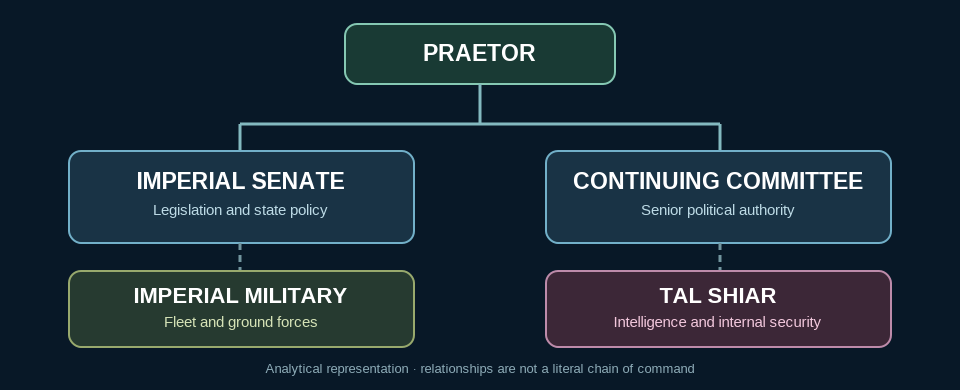
Romulan political authority is exercised through the Praetor, the Romulan Senate, and a hierarchy of senior state officials. Senators represent imperial provinces or other constituencies. The Praetor occupies the foremost political office and presides over the Senate; the titles Proconsul and Vice-Proconsul are also recognised in the imperial government. Individual officeholders and the practical division of duties can change during periods of political instability.
The Continuing Committee is an influential high-level body chaired by the Praetor. It brings together selected senior officials and has authority in sensitive affairs. The Tal Shiar's leadership may participate in such bodies, although political membership and intelligence authority must not be assumed to be equivalent.
Praetor
Leads the imperial government and presides over the Senate. Starfleet diplomatic channels use the relevant office and rank rather than treating a fleet commander as the head of state.
Imperial Senate
Central legislative and political institution. Senatorial alliances, provincial interests and succession disputes may influence external policy.
Continuing Committee
Senior political body concerned with high affairs of state. Its membership and deliberations are not ordinarily accessible to foreign observers.
Military and intelligence agencies
The fleet and Tal Shiar are distinct institutions with overlapping security interests. Their rivalries can have direct operational consequences.
Source qualification: Specific names of officials and finer details of the imperial system should be recorded only when supported by reliable dated intelligence. Later government arrangements must not be projected backwards into this entry.
The Tal Shiar
The Tal Shiar is the Empire's intelligence and internal-security service. Its responsibilities encompass espionage, surveillance, counter-intelligence, political security and covert operations. Tal Shiar personnel may exercise authority over ordinary military officers and operate under directives unavailable to the fleet command structure. The organisation's secrecy makes its true capabilities difficult to establish.
Evidence from earlier encounters indicates that Tal Shiar officials can intervene aboard military vessels and conduct extraterritorial operations. Contacts with apparent Romulan government representatives should therefore be assessed against available communications authentication, command authority and known intelligence activity. Neither the uniform of an officer nor diplomatic identification alone establishes the full purpose of an operation.
Internal security
Monitoring loyalty to the Empire, identifying dissidents and investigating alleged subversion. Documented practices include detention and disappearance of political critics.
Foreign intelligence
Covert monitoring of other powers and operations designed to acquire strategic information or shape an opponent's decisions.
Relationship with the fleet
Tal Shiar officers can supersede routine military authority, contributing to mistrust between intelligence personnel and ship commanders.
Independent deployments
The organisation can command operational assets, including warships, for missions separate from ordinary fleet tasks.
A Romulan underground movement seeking greater freedom and eventual reconciliation with Vulcan has also operated within the Empire. Its existence demonstrates that Romulan society is not politically uniform and that dissenting citizens should not be equated with official state policy.
Historical development
The Romulan people share ancient ancestry with the Vulcans. Accounts of the distant separation of those populations remain of historical interest to both societies. The Empire subsequently developed into a powerful state with a long record of conflict and diplomacy involving Earth, the Federation and the Klingon Empire.
- Ancient era: The ancestors of the Romulans depart Vulcan during the separation of Romulan and Vulcan populations. The later imperial civilisation develops its own social and political institutions.
- 2156–2160: The Earth–Romulan War is fought between United Earth and the Romulan Star Empire. Its settlement leads to the establishment of a neutral buffer between the adversaries.
- 2266: A Romulan Bird-of-Prey violates the Neutral Zone and attacks Federation outposts, producing a dangerous confrontation with the USS Enterprise.
- 2311: The Tomed Incident causes severe losses and leads to the Treaty of Algeron. The Neutral Zone is reaffirmed; the Federation accepts restrictions on developing and using cloaking technology.
- 2364: After decades of limited official contact, the Empire's warships reappear near the Neutral Zone amid attacks on outposts.
- 2366: Encounters involving suspected Romulan deployments and a prominent Romulan defector intensify strategic suspicion and underscore the potential for misdirection.
- 2367–2368: Romulan assistance to a faction in the Klingon civil war is exposed. A separate scheme involving proposed Romulan–Vulcan reunification is revealed to include a plan for military occupation of Vulcan.
- 2369: An underground-assisted defection involving Vice-Proconsul M'ret illuminates tensions between the state, the Tal Shiar and reform-minded Romulans.
- 2370–2371: The Dominion's appearance prompts cautious exchanges and renewed strategic calculations. Romulan cooperation permits a cloaking device to be installed on the USS Defiant under negotiated conditions.
- 2371, subsequent reports: A covert Tal Shiar–Obsidian Order expedition to the Gamma Quadrant is destroyed during an assault on the Founders' presumed homeworld in the Omarion Nebula.
Romulus, Remus and imperial territory
Romulus is the capital and principal political centre of the Empire. The Romulus system also includes Remus, a world associated with extensive industrial and mining operations. Starfleet possesses incomplete public information about Reman society and the internal administration of the system. Detailed claims about local conditions should be checked against source classification and reporting date.
The Empire occupies a substantial region of the Beta Quadrant with holdings extending into the Alpha Quadrant. Its political boundary with the Federation includes the Romulan Neutral Zone, regulated by treaty. The precise frontier is not represented adequately by a simple flat illustration; authorised navigational charts and current treaty records take precedence.
Romulus
Imperial capital, site of government institutions and a major centre of Romulan cultural and political life.
Remus
Inhabited world within the Romulus system, associated with mining and industrial activity. The status and welfare of its inhabitants require separate assessment.
Neutral Zone
Treaty-regulated frontier between the Federation and the Empire. Unauthorized passage may provoke a grave diplomatic or military incident.
Other holdings
Colonies, fleet facilities, administered worlds and strategic installations are not necessarily fully charted in publicly accessible Federation records.
Romulan fleet and military technology
The Empire maintains a formidable fleet capable of patrol, power projection, reconnaissance and major fleet engagements. Romulan warships are frequently equipped with cloaking devices and may exploit surprise, carefully prepared positions and the threat of escalation. Their military equipment should not be assumed identical across every class or period of construction.
| Known capability | Operational characteristics |
|---|---|
| D'deridex-class warbird | Large and powerful capital warship, also operated in Tal Shiar deployments. Carries substantial weapons systems, defensive systems and a cloaking device. |
| Romulan cloaking technology | Reduces a vessel's detectable signature. Effectiveness and sensor vulnerability vary with equipment, environmental conditions and operational mode. |
| Artificial quantum singularity power | Some major Romulan starships use a confined singularity as their primary energy source, unlike the standard Federation matter–antimatter arrangement. |
| Scout and science craft | Smaller vessels perform reconnaissance, scientific investigation and support duties; not all contact with an imperial vessel is military. |
| Warship command | Military officers may employ ranks including Commander, Sub-Commander and higher flag or field ranks; Tal Shiar personnel maintain overlapping but distinct authority. |
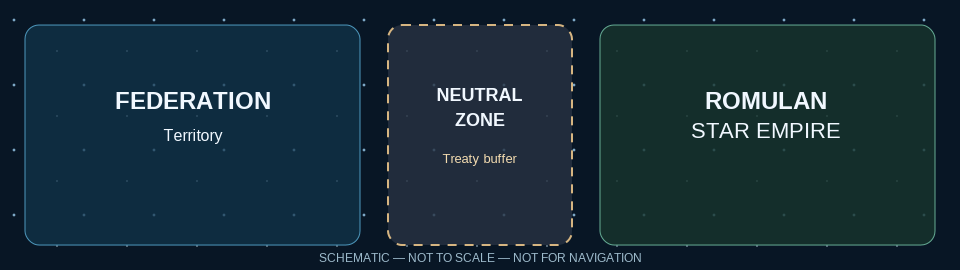
Tactical reference: A loss of positive sensor contact does not establish that a Romulan craft has departed. Assess propulsion signatures, emissions, environmental interference and corroborating contacts. Follow established treaty procedures before crossing the Neutral Zone.
Society, language and cultural traditions
Romulan society places importance upon political loyalty, state service, reputation and familial affiliations. Its institutions and civic traditions have developed independently from the shared prehistory with Vulcan. Romulans commonly express emotions openly, in contrast to the prominent discipline of logic associated with many Vulcans. These tendencies must not be treated as fixed attributes of individual citizens.
Language
Romulan is the principal language of the Empire. Translators support routine exchanges, although diplomatic terminology and formal titles may require verification.
State and citizenship
Imperial institutions place a high priority on political loyalty and security. Information about civic rights, provincial variation and legal protections is less complete than equivalent Federation records.
Family and identity
Kinship, ancestry and obligations to family can influence Romulan personal affairs. Individual views of the state and the Federation vary greatly.
Intellectual and political life
Scientists, diplomats, reformers and underground organisations exist alongside imperial military institutions. Romulan society is broader than its intelligence and defence apparatus.
Starfleet personnel should avoid assuming every Romulan contact is a military agent or Tal Shiar operative. At the same time, politically sensitive interactions require the same disciplined reporting and security precautions as encounters with any foreign power.
Romulan and Vulcan reunification
The division between the Romulan and Vulcan peoples is ancient, but common ancestry remains an important subject for scholars and advocates of peaceful reunification. Ambassador Spock has pursued contact with an underground movement on Romulus. In 2368, the Empire attempted to exploit apparent reunification negotiations for a plan to introduce Romulan forces onto Vulcan; Starfleet exposed and disrupted the scheme.
That episode did not eliminate the genuine underground movement. Reports of individuals seeking reconciliation and reform indicate that official imperial conduct should not be conflated with every Romulan citizen's aspirations. Conversations concerning reunification may be politically sensitive and could endanger local participants if mishandled.
Diplomatic caution: Do not identify confidential Romulan dissidents in unprotected communications or disclose their affiliations without applicable authorisation and safeguards.
Foreign relations — 2371 assessment
| State or organisation | Relationship and concerns |
|---|---|
| United Federation of Planets | Long-standing strategic rivalry tempered by diplomacy and treaty obligations. Cooperative exchanges exist where mutual interests justify them, including limited arrangements against the Dominion. |
| Klingon Empire | Deep historical hostility; Romulan intervention in the Klingon civil war remains a recent source of mistrust. |
| Cardassian Union | No general alliance. Elements of the two intelligence services nevertheless coordinate in a covert operation against the Dominion during 2371. |
| Dominion | Emerging external threat. Knowledge of Dominion politics, capabilities and infiltration methods remains incomplete, particularly before the Omarion operation. |
| Bajor | Independent regional state and location of a strategically important wormhole; relations should be assessed through actual diplomatic and operational contacts. |
| Ferengi Alliance | Independent commercial power. Economic contact does not establish a close political alliance. |
Intelligence update: Omarion Nebula, 2371
During 2371, elements of the Tal Shiar and the Cardassian Obsidian Order secretly assemble a combined strike force intended to destroy the Founders of the Dominion. The force travels through the Bajoran wormhole and attacks the presumed Founder homeworld in the Omarion Nebula.
Following the bombardment, the attacking force is intercepted and destroyed by a numerically superior force of Jem'Hadar ships. The operation severely weakens the Tal Shiar and devastates the Obsidian Order. Its failure demonstrates the Dominion's capacity for deception and major fleet engagements far from its core territory.
Report-date requirement: This is a subsequent intelligence update within the year 2371, not a fact available at the beginning of that year. Records and orders prepared before confirmation of the engagement must not rely on the outcome.
The losses are an important strategic development, but do not by themselves demonstrate that the Romulan government, Senate or fleet has ceased functioning. Their longer-term political consequences remain under assessment.
Starfleet operational reference
Neutral Zone patrols
Maintain confirmed position and treaty status. Escalate ambiguous contacts through command; do not conduct unauthorised pursuit across the frontier.
Contact authentication
Confirm ship, command and diplomatic identities independently where feasible. Tal Shiar and military channels may convey different orders or priorities.
Intelligence assessment
Separate directly observed facts from inference. Mark source reliability and the date of confirmed sightings, especially for cloaked ships.
First-contact etiquette
Use formal rank and diplomatic titles. Avoid assumptions based solely on Vulcan ancestry or Romulan stereotypes.
Rescue obligations
Requests for humanitarian assistance must be evaluated under Starfleet law and duty-of-care obligations without assuming that distress is automatically a deception.
Strategic reporting
Record unusual propulsion, cloaking or sensor signatures with confidence levels. Escalate potential treaty violations through the chain of command.