
STARFLEET LIBRARY COMPUTER · FOREIGN POWERS · 2371
Klingon Empire
Political authority, military organisation, history, customs and relations with the United Federation of Planets
The Klingon Empire is a major interstellar state centred on Qo'noS, governed by the Chancellor and the Klingon High Council. Its political institutions combine the authority of powerful Great Houses, military service and deeply influential traditions of honour, ancestry and duty. Since the Khitomer peace settlement, the Empire has maintained a strategically important alliance with the United Federation of Planets.
Although the alliance has survived serious internal disputes and external interference, Starfleet personnel should not assume that Klingon interests, customs or legal obligations are identical to Federation practice. Effective cooperation depends upon respect for Klingon institutions and an understanding of the distinctions between imperial government, Great House obligations and individual command responsibility.

Government and the Great Houses
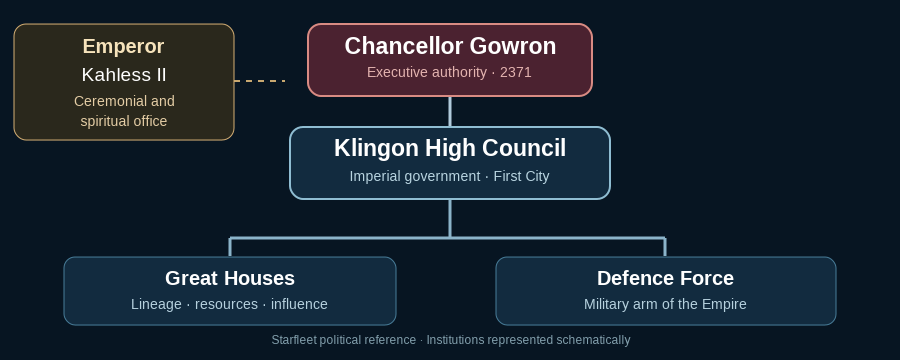
Executive political authority is exercised by the Chancellor of the Klingon High Council. The Chancellor presides over the Council and directs the Empire's government, external policy and military priorities. Gowron, son of M'Rel, holds the chancellorship following the succession crisis of 2367 and subsequent civil war.
The High Council
Meeting in the Great Hall of the First City, the Council is formed from influential Klingon houses and political leaders. Its members debate imperial policy and exercise significant power over military, territorial and domestic affairs. Control of the Council is central to the legitimacy of a Chancellor.
Great Houses
Great Houses are extended political and familial institutions, often controlling ships, estates and resources and maintaining retainers or allies. Kinship, marriage, inheritance, sworn loyalty and public reputation can affect an individual's career as much as military rank.
Imperial succession
Succession has historically involved formal rites, nominated contenders and challenges overseen by an Arbiter of Succession. Legal ritual does not remove the possibility of intrigue, factional rivalry or armed conflict.
Emperor Kahless II
In 2369, the appearance of a figure recognised as Kahless led to restoration of the imperial office. The individual was established to be a clone of Kahless the Unforgettable, but retains the role of symbolic and spiritual leader. Governmental authority remains with Gowron and the High Council.
Institutional distinction: The Emperor's position must not be confused with command of the government or the Klingon Defence Force.
Historical development
Klingon accounts attribute the unification of the ancient Empire to Kahless the Unforgettable, whose victory over the tyrant Molor occupies a central place in imperial history and tradition. The Empire developed into a formidable interstellar power with a long record of expansion, conquest, dynastic change and conflict with neighbouring states.
- Ancient period — Kahless becomes the Empire's foundational figure; the Great Houses develop as key centres of authority.
- 22nd–23rd centuries — Prolonged rivalry and armed confrontations with Earth and later the Federation shape relations along the frontier.
- 2293 — Destruction of the moon Praxis severely damages the Empire's strategic position; Chancellor Gorkon pursues peace with the Federation. The Khitomer negotiations begin a new diplomatic era.
- Mid-24th century — Cooperation develops into a formal Federation–Klingon alliance, permitting diplomatic and military exchanges.
- 2367–2368 — A succession dispute following K'mpec's death develops into the Klingon Civil War. Gowron emerges as Chancellor; evidence of Romulan assistance to his opponents damages confidence in Romulan intentions.
- 2369 — The ceremonial imperial office is restored with Kahless II.
- 2371 — The Empire remains a Federation ally, though the House of Duras controversy and longstanding rivalry with the Romulan Star Empire continue to influence politics.
Current intelligence does not establish any subsequent rupture of the Federation–Klingon alliance. Future security assessments must be based on confirmed reports, not speculation.
Qo'noS and imperial territory
Qo'noS, also rendered Kronos in Federation Standard, is the Klingon homeworld and the centre of imperial administration. The First City houses the Great Hall, where the High Council assembles. The planet is also a central site of Klingon cultural and ceremonial life.
Imperial territory encompasses numerous worlds and military holdings. Exact borders may be contested or subject to changes in local jurisdiction; an individual Great House's sphere of influence does not necessarily correspond to a separately sovereign state. Klingon military and civilian traffic extends beyond the capital systems, and ships may act under imperial orders, house obligations or particular commanders' authority.
Cartographic reference
The Federation's compiled territorial chart depicts Klingon space alongside Federation, Romulan and Cardassian regions. Positions, routes and frontiers are indicative at the chart's published scale.
Access the galactic cartographic record →Klingon Defence Force
The Klingon Defence Force maintains the Empire's military fleet and associated ground forces. Military command places great emphasis on personal initiative, tactical aggression, reputation and the duty of a warrior to uphold the honour of ship and crew. Command relationships, however, remain subject to imperial and house politics.
| Vessel type | Operational context |
|---|---|
| Bird-of-Prey | Agile warship employed for patrol, reconnaissance, escort, raiding and fleet actions; variants differ considerably in size and capability. |
| K't'inga-class battle cruiser | Long-serving cruiser design, still encountered in 24th-century imperial service. |
| Vor'cha-class attack cruiser | Powerful modern capital warship, employed in major fleet actions and high-value assignments. |
Starfleet personnel may encounter Klingon disruptor systems, photon torpedoes and cloaking devices. Klingon ships do not all possess identical tactical performance. Threat assessments should be based on a vessel's observed configuration and sensor returns rather than its silhouette alone.
Boarding and command: Klingon military personnel may regard a challenge, a test of nerve or an assertion of rank as a formal social act. Such behaviour is not, by itself, evidence of hostile intent. Maintain Starfleet security protocols and seek clarification through the commanding officer.
Society, language and culture
Honour and duty
Honour is central to many Klingon social and political relationships. Conduct judged dishonourable may affect an individual's family and Great House for generations. Concepts of courage, loyalty and the willingness to accept consequences inform military and civilian life, though individuals interpret them differently.
Language
The Klingon language, tlhIngan Hol, is widely used within the Empire. Federation universal translators support many ordinary exchanges, but formal declarations, names, legal rituals and poetry can lose important nuances in translation.
Faith and remembrance
Kahless occupies a revered position in cultural tradition. Many Klingons believe that the honoured dead may enter Sto-vo-kor, while Gre'thor is associated with dishonour. Ceremonies surrounding death can appear stark to officers unfamiliar with Klingon customs.
Family and hospitality
Household affiliations and ancestral obligations frequently influence professional and personal decisions. Feasts, song, story, ceremonial drinking and contests can serve diplomatic or familial purposes as well as recreation.
Common cultural references
| Term | Starfleet reference |
|---|---|
| bat'leth | Traditional curved Klingon blade used in combat and ceremonial practice. |
| Mok'bara | Klingon martial discipline emphasising movement, balance and control. |
| Sto-vo-kor | Honoured afterlife within Klingon belief. |
| Rite of Succession | Traditional procedures governing selection of a Chancellor. |
| Discommendation | Severe social and legal dishonour imposed upon an individual or a House. |
Law, challenges and political honour
Klingon law is strongly influenced by status, tradition and the authority of the High Council. Formal challenges and recognised rights of vengeance can exist alongside courts and political proceedings. A member of a discommended House may suffer loss of standing and rights; however, particular retained rights can depend on established custom and circumstances.
The concept of discommendation is not simply a reprimand. It can result in exclusion of an individual or family from much of Klingon public life, adversely affecting employment, political influence and honour. House disputes are therefore not always private matters: they may shape the conduct of Klingon officials and military vessels.
Diplomatic handling: Federation personnel should not attempt to adjudicate Klingon inheritance, honour or succession claims under Federation law without a recognised legal basis. Refer serious disputes to the commanding officer and the appropriate diplomatic authorities.
Foreign relations — current assessment, 2371
| Power | Relationship |
|---|---|
| United Federation of Planets | Allied. Strategic cooperation is supported by the peace settlement and subsequent alliance. Cultural differences and individual political disputes remain possible. |
| Romulan Star Empire | Historically adversarial. Romulan involvement in the recent Klingon civil conflict remains an important cause of suspicion. |
| Cardassian Union | Separate regional power. Relations are influenced by strategic competition and the broader balance of power. No Klingon–Cardassian general war is established in this 2371 record. |
| The Dominion | Developing intelligence concern. Information from the Gamma Quadrant is incomplete; any claims of specific future imperial policy are speculative. |
| Bajor | Independent world. Klingon diplomatic activity may intersect with the Federation's presence at Deep Space Nine. |
| Ferengi Alliance | Commercial contacts. Trading and individual merchant activity occur across political boundaries. |
Starfleet operational reference
Diplomatic contact
Address senior officers by their recognised titles and respect the Klingon chain of command. Acknowledging a commander's House or lineage can be appropriate when verified.
Joint operations
Confirm mission authority, communications conventions, rules of engagement and responsibility for prisoners or recovered property before deployment.
Medical and religious customs
Where operationally safe, accommodate requests concerning treatment, the dead and cultural observances. Medical intervention remains governed by patient consent and applicable regulations.
USS Ermiana records
Recent encounters with Duras-associated Klingon personnel during the Veridian recovery operation and subsequent contact with Dahar Master Rorek demonstrate the importance of recognising different Klingon loyalties and motivations.
Operation Enterprise / Klingon encounter → · Dahar Master Rorek's visit → · Klingon personnel relations →