
STARFLEET LIBRARY COMPUTER · FOREIGN POWERS · 2371
Cardassian Union
Government, historical development, security institutions, culture and relations with the United Federation of Planets
The Cardassian Union is a major Alpha Quadrant state centred on Cardassia Prime. Its institutions formally recognise civilian administration through the Detapa Council; in practice, the Cardassian Central Command and the Obsidian Order have exercised decisive political, military and internal-security power. The Union has a long history of territorial expansion, tightly controlled public institutions and conflict with neighbouring worlds.
Relations with the United Federation of Planets have improved following peace agreements and revised border arrangements, but resentment over disputed colonies, the activities of the Maquis and unresolved consequences of the Cardassian occupation of Bajor continue to threaten the peace. Starfleet vessels approaching the frontier should treat declared government policy, military activity and covert intelligence operations as related but not necessarily identical interests.

Government and administration
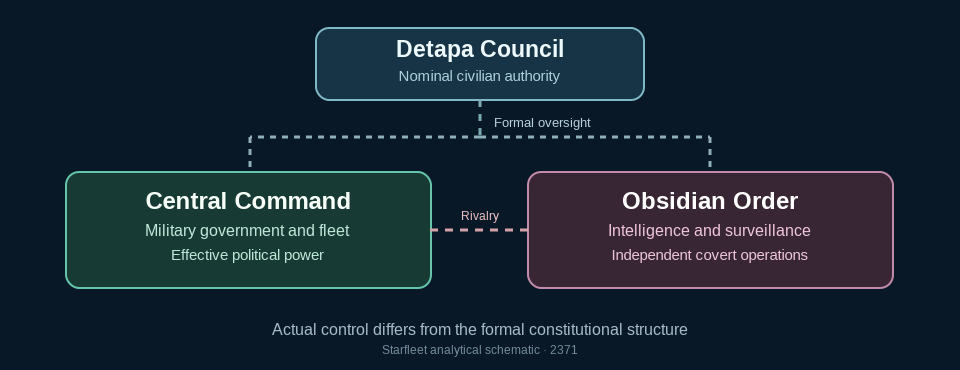
The governing structure of the Cardassian Union combines the Detapa Council, the Central Command and the Obsidian Order. The Detapa Council possesses formal civilian standing, but for much of the recent era the military and intelligence establishments have held the power to enforce policy, determine external commitments and suppress opposition. The two security institutions are powerful but are not always aligned: rivalry between Central Command and the Obsidian Order complicates Cardassian policy.
Detapa Council
The civilian assembly is the Union's nominal governing authority. Its power over the military has been severely restricted. Its existence should not be mistaken for effective civilian control over the security establishment.
Central Command
The central military organisation exercises extensive government authority, appoints senior commanders and directs territorial, fleet and security priorities. Orders issued by military officials may carry direct administrative consequences beyond strictly military matters.
Obsidian Order
The intelligence organisation oversees covert operations, surveillance and internal political security. Its agents may operate separately from ordinary military channels, and even senior officers may have limited knowledge of Order operations.
Opposition and reform
Dissident Cardassians have challenged military dominance and sought restoration of civilian authority. The movement includes civilians and officials; treating all Cardassians as supporters of Central Command would be a serious analytical error.
Current-intelligence qualification: The Obsidian Order's losses at the Omarion Nebula in 2371 significantly affect this balance. Confirmation and political consequences should be assessed by the date of the individual intelligence report; a full civilian transfer of power has not been established as part of the present record.
Historical development
Cardassian civilisation possesses a substantial pre-modern artistic and cultural heritage. In more recent centuries the Union developed an expansionist military state, increasingly concentrating authority in uniformed and intelligence institutions. Resource needs, economic pressures, territorial ambition and state ideology have all been offered as explanations for expansion; no single explanation accounts for every government decision.
- Earlier Cardassian civilisation — established artistic and architectural traditions precede the present military-dominated state.
- 19th century — the political institutions associated with Central Command, the Detapa Council and the Obsidian Order emerge in the Union's history.
- 24th century — a prolonged period of conflict with Federation forces and frontier colonies produces deep mistrust between Cardassian and Federation populations.
- 2369 — Cardassian military forces withdraw from Bajor after decades of occupation. The former Cardassian station Terok Nor becomes Deep Space Nine under Bajoran ownership and Starfleet administration.
- 2370 — revised Federation–Cardassian territorial arrangements establish or modify the Demilitarized Zone; the Maquis movement grows among settlers opposed to the settlement.
- 2371 — Cardassian military deployments in disputed regions, the theft of the Federation starship Defiant by a Maquis operative, and allegations of secret military buildup sustain frontier tensions.
- 2371, later intelligence — a combined Obsidian Order–Tal Shiar attack on the Dominion in the Omarion Nebula ends in disastrous losses for the assaulting fleet and causes severe disruption to Cardassian intelligence capabilities.
Chronology control: A mission report dated earlier in 2371 must not assume knowledge of later 2371 events. This summary incorporates subsequently received reports without forecasting later outcomes.
Cardassia Prime and Union territory
Cardassia Prime is the homeworld, capital and principal centre of Cardassian political and military administration. The wider Cardassian Union comprises settlements, administered worlds and strategic holdings across part of the Alpha Quadrant. Not all inhabited worlds within or bordering the Union are ethnically Cardassian, and past occupations have left contested loyalties and unresolved territorial claims.
Federation navigators should consult current Starfleet cartographic and treaty databases for the legal status of individual systems. Border arrangements and administrative control may differ, and the revised treaty has left communities on both sides of the frontier dissatisfied with their assigned jurisdiction. No simplified single-plane galactic chart should be used as a substitute for navigational or legal territorial records.
Cardassia Prime
Centre of government, military command, state institutions, cultural traditions and extensive population centres.
Demilitarized Zone
A treaty-defined frontier area containing disputed settlements, sensitive patrol routes and communities affected by changes in sovereignty.
Bajor sector
Strategically important region neighbouring former Cardassian holdings. The Cardassian withdrawal from Bajor has not removed all diplomatic grievances.
Badlands approaches
Dangerous plasma phenomena and sensor limitations complicate operations in nearby regions and offer concealment opportunities to irregular vessels.
Cardassian military
The military is a central institution of the Union. Its officers oversee fleet operations, planetary garrisons, border security and other state responsibilities. Cardassian strategy has often combined disciplined formations, political pressure, deception, covert support and the exploitation of regional intelligence. These are observed tendencies rather than guarantees about every Cardassian commander.
| Rank or role | Operational context |
|---|---|
| Legate | Senior military and strategic leadership; ranks above a Gul. |
| Gul | Senior officer frequently commanding warships, stations or military operations. |
| Glinn | Subordinate officer rank commonly found in a Gul's command structure. |
| Galor-class cruiser | A principal Cardassian military starship, routinely encountered on patrol, escort and fleet assignments. |
| Keldon-class cruiser | A larger related warship design employed in major fleet operations. |
The Union's forces are divided into numbered military orders and other command structures. For a particular encounter, identify the ship's known affiliation and commanding officer rather than assuming all vessels answer to a single local Gul.
The Obsidian Order
The Obsidian Order has a reputation for extensive domestic surveillance, secrecy, coercive interrogation and sophisticated infiltration. It has conducted intelligence operations beyond the Union and has periodically worked at cross-purposes with Central Command. Its activities are also a major reason that official statements from a Cardassian military officer cannot necessarily be treated as a complete account of Cardassian state intentions.
Although the organisation has a formal intelligence remit rather than a recognised independent standing army, its operational resources and reach make it a major security actor. The emergence of independent intelligence projects and the large-scale losses suffered in the Omarion Nebula in 2371 demonstrate the danger of treating the Order as either entirely subordinate to or entirely indistinguishable from Central Command.
Starfleet security guidance: Verify credentials, protect sensitive shipboard systems, maintain compartmentalised access and consult the commanding officer and Intelligence Department before sharing classified Federation information with personnel claiming covert Cardassian authority.
Society, culture and daily life
Family and ancestry
Kinship and family obligations carry considerable social importance. Cardassian citizens may speak of familial continuity, children and obligations to the state together, although individuals differ in their priorities and relationships.
Education and public service
Cardassian institutions emphasise education, memory, discipline and contribution to society. Official pronouncements about educational excellence should be distinguished from independent assessments of teaching and freedom of inquiry.
Literature
Cardassian literary traditions include the multi-generational family epic The Never Ending Sacrifice, and mystery or 'enigma' stories in which the explanation of wrongdoing is a central theme.
Art and architecture
Cardassian design includes imposing state architecture, ceremonial spaces and elements intended to convey institutional authority. More ancient cultural achievements demonstrate traditions that cannot be reduced to modern military administration.
Religion and ideology
Historical beliefs and cultural practices coexist with strong contemporary state institutions. Officers should avoid assuming that public loyalty to the government necessarily reveals a citizen's private convictions.
Conduct during contact
Respect formal titles and social expectations, avoid unwarranted generalisations about individuals, and distinguish political criticism of Union institutions from hostility toward Cardassian civilians.
Justice and civil liberties
The Cardassian justice system assigns great weight to the state and to public demonstrations of guilt and punishment. Documented cases indicate that a criminal trial may serve as an affirmation of an already established official conclusion, rather than an independent inquiry into whether the accused committed an offence. Political detainees and dissidents can face substantial risk.
Federation personnel should distinguish the legal position of their own citizens, Cardassian subjects, prisoners of war and civilians in disputed territory. Detention, search, extradition and evidence-sharing raise questions governed by applicable treaties and Starfleet orders; political assurances from a single officer are not a substitute for a formal agreement.
Occupation of Bajor and its aftermath
The Cardassian Union occupied Bajor for decades before withdrawing in 2369. The occupation involved forced labour, political repression, extensive exploitation and the loss of many Bajoran lives. Bajoran resistance movements fought Cardassian rule over many years. These events remain central to the relationship between Bajor and the Union and continue to shape security conditions near Deep Space Nine.
Following the withdrawal, Bajor established an independent provisional government. The former Cardassian space station Terok Nor was transferred to Bajoran control and is now operated as Deep Space Nine with Starfleet assistance. This arrangement does not make Bajor a member of the Federation.
The discovery of the stable wormhole near Bajor increased the region's importance to surrounding powers and encouraged greater Federation attention to Bajoran security. Mutual distrust, accountability for occupation-era conduct, and the return of property or displaced persons remain difficult diplomatic subjects.
Foreign relations — 2371 assessment
| Government / group | Current relationship |
|---|---|
| United Federation of Planets | Peace treaty in effect. Border changes, disputed settlements and Maquis activity create significant friction. |
| Bajor | Independent former occupied world. Relations remain burdened by occupation-era abuses and security concerns. |
| Maquis | Irregular armed opposition. Maquis cells attack or threaten Cardassian military and civilian targets; Federation law and Cardassian accounts differ on some incidents. |
| Klingon Empire | Separate great power. Relations are historically complex; the Federation–Klingon alliance remains in force during this period. |
| Romulan Star Empire | Strategic rivalry and covert contact. A clandestine Obsidian Order–Tal Shiar operation against the Dominion produces major repercussions in 2371. |
| The Dominion | Emerging strategic danger. Reliable information concerning Dominion intentions is incomplete; the Omarion defeat demonstrates substantial Dominion military strength. |
| Ferengi Alliance | Commercial interaction. Ferengi traders operate across numerous political frontiers. |
Starfleet operational reference
Identification and contact
Request vessel identification, identify the commanding Gul where possible, and confirm claimed patrol or jurisdictional authority against current treaty records.
Border navigation
Consult the latest demarcation data and independent sensor tracks. Apparent Cardassian pursuit of Maquis craft does not by itself establish permission for entry into Federation space.
Boarding and security
Maintain cargo transporter safeguards, protect security authorisations and preserve sensor records of any interference or unusual shield-cycle events.
Medical and humanitarian situations
Handle civilian protection, asylum, prisoners and treatment needs under applicable Federation regulations, avoiding assumptions based solely on species or uniform.
Related USS Ermiana operations: The recovery of the USS Bismarck placed the crew amid Maquis and Cardassian tensions. Subsequent transport of Starfleet armaments to Deep Space Nine likewise raised questions about Cardassian vessels, covert activities and the security of military supplies. These shipboard accounts are catalogued separately.
The Search — Maquis and Bismarck operation → · Preparations — armaments transport →