
STARFLEET LIBRARY COMPUTER · BORDER AFFAIRS · 2371
The Maquis
Federation–Cardassian Demilitarized Zone · colonial resistance · security and diplomatic assessment
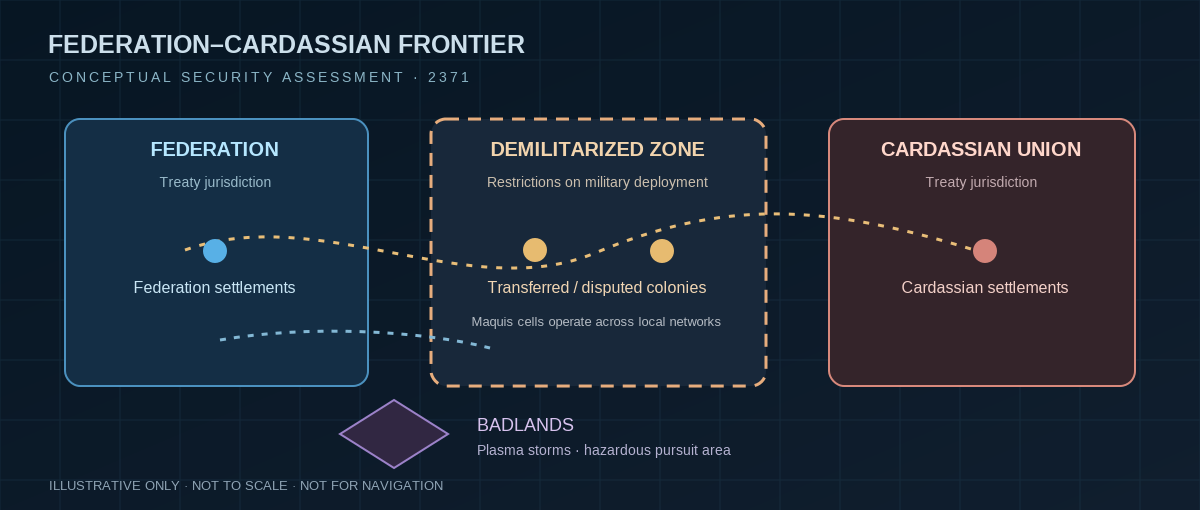
The Maquis are a decentralised armed resistance movement operating primarily among disputed and transferred colonies along the Federation–Cardassian Demilitarized Zone (DMZ). Emerging during 2370, the movement draws much of its support from colonists who reject the territorial and jurisdictional arrangements of the latest Federation–Cardassian treaty, particularly where long-established Federation settlements have passed under Cardassian authority.
Maquis personnel include civilians, former Starfleet officers and individuals of several species. The movement claims to defend threatened communities against intimidation and attacks. Its forces have nevertheless acquired illicit weaponry, conducted strikes against Cardassian targets and interfered with Starfleet operations. The Federation does not recognise the Maquis as a sovereign government or as an authorised military force.
Intelligence scope: Assessment current to 2371. The organisation has no verified central government or single universally accepted commander. Information concerning individual cells, leadership and incidents is subject to change.

Origins: the Federation–Cardassian peace settlement
The border conflict between the Federation and Cardassian Union brought years of insecurity to frontier settlements. A ceasefire in 2366 reduced open hostilities, but the status of contested colonies remained unresolved. Negotiations culminated in a new territorial settlement in 2370. The agreement redrew parts of the border, exchanged jurisdiction over affected worlds and established restrictions on the deployment of military vessels within a Demilitarized Zone.
Some colonists were offered resettlement rather than remaining under the administration of the other power. Others elected to stay on worlds on which they had built homes, farms and communities. For many, the political settlement appeared to sacrifice their security and local autonomy to the wider diplomatic objective of ending interstellar warfare.
Reports of weapons reaching Cardassian settlers through third-party intermediaries deepened distrust. Armed clashes between colonial communities followed. The Maquis emerged from this environment, arguing that self-defence was necessary where treaty protections and official investigations had proved inadequate.
Federation objective
Preserve a negotiated peace, protect civilians and prevent renewed fleet-level conflict across the frontier.
Maquis position
Resist perceived Cardassian coercion and assert the right of established colonists to defend their homes.
Cardassian position
Assert recognised territorial jurisdiction and demand action against armed colonial groups crossing or attacking within Cardassian territory.
Underlying difficulty
Treaty boundaries do not erase local attachments, longstanding grievances or the risk of covert weapons transfers.
Organisation, command and recruitment
The Maquis are best understood as a network of local resistance cells, not a formal interstellar state or conventional armed service. Cells may organise around a particular colony, group of ships or field commander. Arrangements for intelligence-sharing, logistics and mutual assistance exist, but do not establish a single chain of command across the entire movement.
Personnel are recruited through frontier communities and sympathetic networks. Recorded members include Humans, Bajorans, Vulcans and other species. Former Starfleet officers are particularly significant because they bring tactical training, vessel-handling expertise, familiarity with Federation procedures and knowledge of command culture. They do not retain authority to act on Starfleet's behalf after resignation or desertion.
Equipment and supplies are obtained through civilian channels, black-market transactions, sympathetic intermediaries and seizures. Cells may use ordinary commercial infrastructure to conceal communications and movement. Public sympathy for threatened colonists must not be treated as proof that a particular merchant or resident is aiding the resistance.
Known persons and associated incidents
Calvin Hudson
Former Starfleet lieutenant commander and attaché to the colonies. Became an influential Maquis organiser in 2370 after concluding that Federation policy failed to protect frontier civilians. His activities brought him into direct conflict with Commander Benjamin Sisko.
Ro Laren
Former Starfleet lieutenant. Assigned to infiltrate the movement during 2370, but defected after developing sympathy for the colonists. Her disappearance from authorised service is a confirmed security and personnel concern.
Chakotay
Former Starfleet officer and commander of the Maquis raider Val Jean. His vessel was pursued into the Badlands by a Cardassian warship in 2371 and subsequently disappeared. Its ultimate fate has not been established in the current Alpha Quadrant record.
Thomas Riker
Former Starfleet officer who impersonated Commander William T. Riker in 2371, seized the USS Defiant from Deep Space Nine and attempted to investigate secret Cardassian activity in the Orias system. He was ultimately taken into Cardassian custody.
Identification warning: Known involvement by one individual does not imply command over all Maquis cells. Rumoured sympathies or former Starfleet service alone do not constitute proof of membership.
The colonies, Demilitarized Zone and Badlands
The Demilitarized Zone is a treaty-defined border region subject to strict limitations on military deployment and installations. Its political geography is unusually complicated: civilian communities remain in place despite changes in sovereignty, and a colonial vessel's origin does not by itself determine which jurisdiction applies.
Dorvan V is a prominent example of a Federation colony transferred to Cardassian control under the 2370 settlement. Other reported areas of unrest include the Volan colonies and settlements affected by continuing disputes over equipment, security and administrative authority. Specific locations must be checked against current treaty records rather than assumed from a general sector chart.
The nearby Badlands contain dangerous plasma activity and sensor-disruptive conditions. Maquis craft have used the region to evade pursuit, rendezvous or conceal movement. Hazardous navigation also makes rescue and search operations exceptionally difficult. The existence of such refuges does not place the entire region under Maquis control.
Vessels, armament and technical capabilities
Maquis spacecraft are generally smaller than frontline Starfleet or Cardassian warships. Observed types include modified civilian courier vessels, armed transports and raider-type craft. Individual ships often display nonstandard engines, defensive equipment and improvised weapon installations, making class recognition an unreliable guide to capability.
Resistance forces have obtained Federation-pattern equipment, civilian phasers, torpedoes and materials from illicit suppliers. Some cells possess the knowledge to reconfigure vessels for hit-and-run operations. Chakotay's Val Jean illustrates the limitations of these older, modified raiders when facing a Galor-class warship.
Evidence of illegal weapons transfers to Cardassian settlers complicates assessments of individual engagements. Officers should distinguish between a civilian vessel carrying prohibited weapons, a ship firing in immediate self-defence and a planned military strike against a colony or installation.
Typical strengths
Local intelligence, flexible small crews, familiarity with frontier traffic, access to sympathetic supply networks and knowledge of difficult terrain.
Typical constraints
Uneven maintenance, limited heavy-ship support, scarce supplies, fragmented command and uncertain access to secure repair facilities.
Operations, intelligence and tactics
Recorded Maquis operations include ambushes, interdiction of suspected arms shipments, attacks on Cardassian military or colonial targets and attempts to uncover covert Cardassian activity. Such operations may be intended as deterrence or retaliation, but can also endanger civilians and undermine the peace treaty.
The movement relies heavily on local familiarity and deception. Maquis operators may exploit civilian traffic, navigate through hazardous regions or use identity and access privileges to enter controlled facilities. In 2371, the Defiant seizure demonstrated the danger posed by impersonation and unverified command authorisation, even aboard a well-defended Starfleet installation.
Information handling: Claims that a vessel carries arms, that a colony is preparing an attack or that a ship is sheltering Maquis personnel require corroboration. The circumstances of the Orias incident demonstrate that apparent military preparations may have explanations beyond those first inferred by either side.
Historical record — through 2371
- 2350s–2360s: Federation–Cardassian frontier conflict and competing colonial claims contribute to prolonged instability.
- 2366: A ceasefire reduces open warfare but leaves major territorial disputes unresolved.
- 2370: The new Federation–Cardassian treaty adjusts the border and defines a Demilitarized Zone; affected colonists are offered resettlement or continued residence under altered jurisdiction.
- 2370: Resistance cells identify themselves as the Maquis. Calvin Hudson joins the movement; Commander Sisko intervenes to prevent an attack on a suspected Cardassian weapons site at Bryma.
- 2370: Lieutenant Ro Laren defects after a Starfleet infiltration assignment. Further small-vessel engagements increase concern over the stability of the frontier.
- 2371: Thomas Riker and associated Maquis personnel hijack the USS Defiant and travel toward the Orias system. Cardassian authorities take Riker into custody following the incident.
- 2371: The Maquis raider Val Jean disappears following pursuit into the Badlands. The USS Voyager, assigned to investigate, is also reported missing.
The chronology is a selection of confirmed or credibly reported incidents. Intelligence concerning unregistered cells remains incomplete.
Legal status and diplomatic consequences
The Maquis' stated purpose of protecting colonial residents does not exempt its members from Federation law, applicable Cardassian law or the provisions of the 2370 treaty. Armed raids, theft, illegal weapons transfers, impersonation and attacks against civilians may result in criminal charges. Federation and Cardassian authorities dispute responsibility for many incidents, making credible investigation particularly important.
Federation policy: Starfleet is responsible for protecting peace and Federation citizens within its jurisdiction while preventing the unauthorised escalation of hostilities. The actions of former officers must not be attributed to Starfleet unless direct evidence establishes official involvement.
Humanitarian obligations: Civilians in the DMZ retain legitimate needs for evacuation, medical assistance, food, engineering services and protection. A colony's political sympathies are not sufficient grounds to deny emergency aid. The distinction between peaceful advocacy, material support and participation in armed operations is essential to proportionate law enforcement.
Regional diplomacy: A single incident may provoke reprisals across multiple settlements or create accusations that the Federation or Cardassian government is acting in bad faith. Commanding officers should preserve complete sensor records, independent witness testimony and a clear chain of custody for seized materiel.
Starfleet operational reference
- Prior to deployment: Verify sector boundaries, patrol limitations and the most recent Federation–Cardassian treaty advisories.
- Contact assessment: Distinguish civilians, armed colonists, confirmed Maquis combatants and official Cardassian personnel. Do not assign status by species or registry alone.
- Ship authentication: Confirm command credentials through independent channels; the Thomas Riker incident demonstrates the risk of identity-based access.
- Vessel searches: Apply lawful authority, preserve the safety of passengers and document the grounds for interdiction or seizure.
- Badlands operations: Prepare for plasma storms, intermittent sensors, degraded communications and difficulties in conducting safe pursuit or rescue.
- Medical assistance: Render impartial emergency care and ensure protected civilian evacuation routes remain viable.
- Evidence: Retain cargo records, tactical logs and sensor data; distinguish verified observations from assertions by interested parties.
- Escalation: Avoid unilateral acts capable of triggering renewed Federation–Cardassian hostilities. Refer strategic and jurisdictional decisions to the authorised chain of command.