
STARFLEET LIBRARY COMPUTER · GALACTIC GOVERNMENTS · 2371
Bajoran Republic
Independent Bajor: civil administration, recovery from occupation, faith, defence and Federation relations
The Bajoran Republic is the independent civil authority governing Bajor and its associated communities following the withdrawal of the Cardassian Union in 2369. In contemporary public records the administration is frequently termed the Bajoran Provisional Government. It is responsible for restoring essential services, rebuilding a war-damaged economy, maintaining internal security and representing Bajor in dealings with neighbouring powers.
Bajor remains a sovereign non-member world. Its government has requested Federation assistance and established a working partnership with Starfleet at Deep Space Nine, the former Cardassian station Terok Nor. Bajor's strategic value has increased greatly since the discovery of the nearby wormhole linking the Alpha and Gamma Quadrants.
Record scope: Consolidated 2371 information. Leadership changes occurring toward the end of the year are identified separately. The terminology “Republic” does not imply Federation membership or the absence of provisional institutions.
Civil government
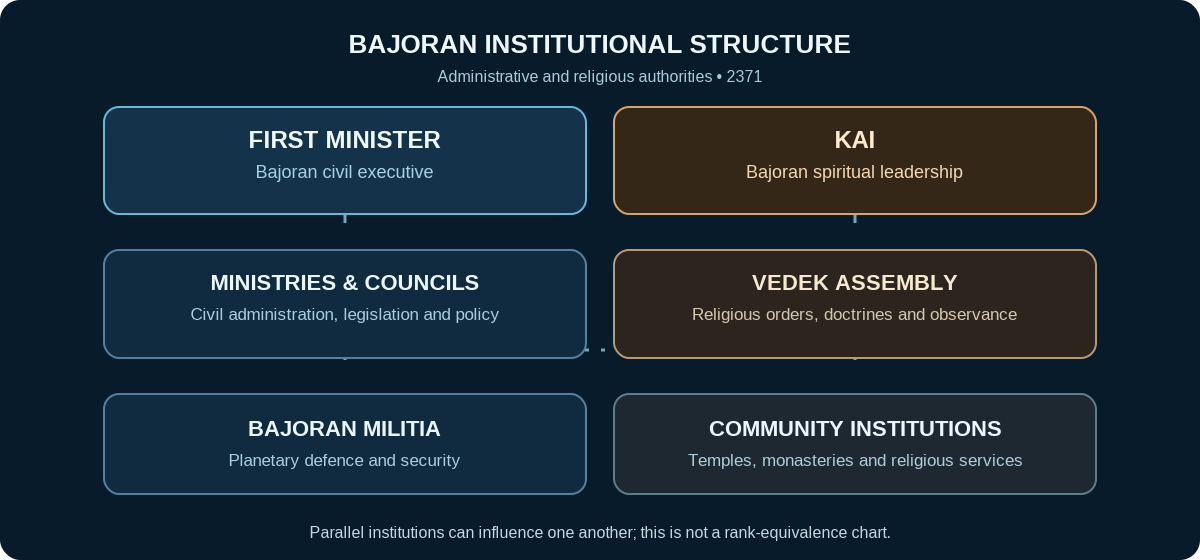
The Provisional Government succeeded the Cardassian-sponsored occupation administration in 2369. Its chief executive is the First Minister, and policy is administered through ministers and legislative bodies referred to in Bajoran records as the Council of Ministers, Chamber of Ministers and related governmental councils. The distinction between these designations is not always consistently reported in outside records; they should not automatically be treated as three wholly separate legislatures.
The First Minister is elected for a six-year term. Ministries and public agencies address agriculture, commerce, reconstruction, archaeological preservation, science and the movement of freight. The government also maintains a security and intelligence apparatus and oversees the Bajoran Militia.
Religious leadership is institutionally distinct from the civil executive, yet the Vedek Assembly and Kai exercise considerable influence in public life. Important policy disputes may involve political ministries, religious figures, local communities and veterans of the resistance.
First Minister and ministries
Direct national policy, resource allocation, diplomacy, administration and reconstruction.
Council of Ministers
Governmental council and legislative deliberation; consult contemporary Bajoran records when interpreting particular ministerial authority.
Bajoran Militia
Planetary defence and security organisation, with officers serving both on Bajor and aboard Deep Space Nine.
Vedek Assembly and Kai
Principal institutions of the Bajoran faith, retaining profound social and political influence without constituting the military chain of command.
Leadership in 2371
Kalem Apren serves as First Minister during much of the period. After his death later in 2371, Kai Winn Adami becomes the acting head of government, temporarily combining the senior positions of civil and religious leadership.
Disagreement over allocation of soil reclamators to farming communities in Dahkur and Rakantha escalates into a political confrontation involving former resistance leader Shakaar Edon. Rather than allowing the dispute to become a civil conflict, Shakaar enters the political contest and is subsequently elected First Minister. Kai Winn remains the spiritual leader of Bajor.
| Period | Civil leadership | Notes |
|---|---|---|
| Earlier 2371 | Kalem Apren | First Minister of the Provisional Government |
| Later 2371, interim | Kai Winn Adami | Acting First Minister while serving as Kai |
| Later 2371, following election | Shakaar Edon | Former resistance commander elected First Minister |
Occupation and independence
The Cardassian occupation, lasting approximately fifty years until 2369, profoundly altered Bajor's society and economy. Cardassian authorities imposed an occupation government, extracted natural resources, employed forced labour and suppressed political opposition. The Bajoran Resistance organised underground networks and armed cells across the planet and beyond it.
The withdrawal of Cardassian forces in 2369 enabled the establishment of the Provisional Government, but left critical infrastructure, agriculture and civil institutions badly damaged. The return of displaced persons and the restoration of confidence in public administration remain ongoing challenges. The distinction between occupation-era collaborators, compelled service and resistance activities continues to influence Bajoran politics and justice.
The unsuccessful Circle movement in 2370 demonstrated the fragility of the new administration. Attempts to exclude Federation personnel and take control of the station were defeated, but divisions over foreign assistance, sovereignty and the meaning of Bajoran independence persist.
Militia and security
The Bajoran Militia provides the Republic's organised defence and many domestic security functions. Its early personnel include substantial numbers of former resistance fighters, whose wartime experience is valuable but whose training and command traditions can differ from Starfleet procedures.
Its officers serve on Bajoran territory and aboard Deep Space Nine. Major Kira Nerys acts as Bajor's senior liaison officer and station first officer, working with the Starfleet station commander. The Militia answers to Bajoran authorities, not directly to Starfleet Command.
Occupation-era intelligence networks, the presence of former collaborators, smuggling risks and the sensitive Cardassian frontier all affect security planning. Bajoran officials retain the authority to enforce Bajoran law, including in the shared station operating environment.
Religious institutions and the Prophets
Religion is central to Bajoran history, identity and public life. The Prophets are revered as divine beings who inhabit the Celestial Temple. Starfleet investigations identify a stable artificial-seeming wormhole near Bajor and entities within it that experience time differently from most humanoid species. These scientific findings do not remove the religious significance attributed to the phenomena by Bajorans.
The Kai is the senior religious leader, selected through the Vedek Assembly. Priests and religious orders serve communities throughout Bajor. Kai Winn Adami holds this position in 2371. Benjamin Sisko, the Starfleet officer commanding Deep Space Nine, is regarded by many Bajorans as the Emissary of the Prophets; this status carries religious and political implications beyond his Starfleet rank.
The sacred Orbs, also known as the Tears of the Prophets, are important spiritual artifacts; several were removed during the occupation. Religious observances, pilgrimage, prayer, seasonal festivals and the significance of an individual's pagh may influence diplomatic and personal interactions.
Operational respect: Starfleet personnel should not dismiss religious sites or Orb experiences as mere curiosities, nor assume that all Bajoran citizens hold identical doctrinal or political views.
Reconstruction, agriculture and economy
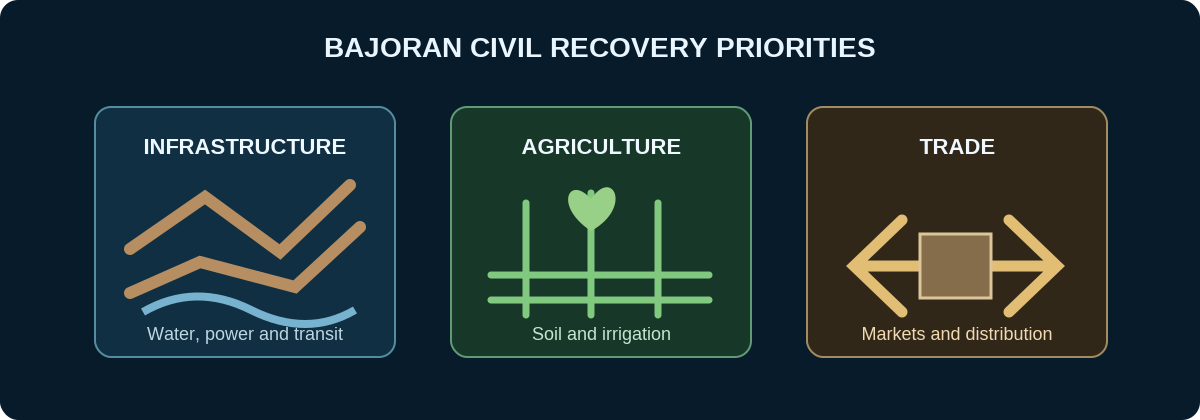
Reconstruction remains a defining governmental responsibility. Occupation-era extraction and industrial activity damaged waterways, soil and agricultural capacity. Bajoran institutions are restoring aqueducts, irrigation systems, farms, settlement facilities, transport routes and civic infrastructure, assisted by Federation humanitarian and technical programmes.
Soil reclamators are especially valuable because contaminated districts cannot be restored quickly by conventional means. The question of which provinces receive reclamation equipment has direct economic and political consequences, as shown by the late-2371 dispute involving Shakaar Edon's farming community.
Bajor's national currency is the lita. The economy includes agriculture, local commerce, shipping and trade opportunities arising from Deep Space Nine's position near the wormhole. Bajor is not a Federation member, and it is inaccurate to assume its economy has adopted all Federation social and commercial practices.
Deep Space Nine and the Bajoran wormhole
The station formerly designated Terok Nor was constructed under Cardassian occupation. After withdrawal it became Deep Space Nine under Bajoran sovereignty, with Starfleet operating the installation at the Republic's request. A Starfleet command officer directs station operations alongside a Bajoran Militia first officer and liaison. The arrangement is cooperative, not a transfer of Bajoran territory to the Federation.
The station was repositioned near the discovered Bajoran wormhole, which connects the Alpha and Gamma Quadrants. Its location creates major opportunities for commerce, scientific investigation and diplomatic contact, alongside substantial security concerns associated with the Dominion and other Gamma Quadrant powers.
Starfleet missions entering the Bajoran sector should observe local traffic control arrangements. Flight-plan and authorisation requirements are established by Bajoran authorities; navigation in the sector is not unrestricted simply because Starfleet assists in operating the station.
Diplomacy and foreign relations
United Federation of Planets
The Republic maintains a close assistance and station-operations partnership. Bajor is not yet a Federation member. Federation admission is a political aspiration, not an accomplished event.
Cardassian Union
Relations are shaped by the occupation, refugees, war crimes, territorial security and unresolved grievances. A 2371 Bajoran–Cardassian treaty marks a significant, contested diplomatic step.
Dominion and Gamma Quadrant
Deep Space Nine's position near the wormhole requires ongoing assessment of Dominion contacts and security risks. Bajoran interests do not invariably coincide with Federation strategic preferences.
Independent traders and travellers
Commercial and passenger traffic through the station affects Bajoran customs, border controls and civilian administration.
In 2371, diplomatic progress with Cardassia is associated with negotiations involving Kai Winn and Vedek Bareil Antos. The agreement remains sensitive because reconciliation is politically difficult for many survivors of the occupation.
Historical record
- Prior to 2319: Bajoran civilisation develops extensive artistic, religious and political traditions.
- Approximately 2319–2369: Cardassian occupation and resistance, accompanied by severe demographic and infrastructural losses.
- 2369: Cardassian withdrawal; independent Provisional Government established; Terok Nor becomes Deep Space Nine; Bajoran wormhole is discovered.
- 2370: Attempted takeover by the Circle fails; Winn Adami becomes Kai.
- 2371: Bajoran–Cardassian diplomatic treaty signed, following negotiations involving Bareil and Winn.
- Later 2371: First Minister Kalem Apren dies; Winn serves temporarily as acting First Minister; Shakaar Edon is elected First Minister.
Chronology: Dates denote events recorded in the 2371 historical file. No subsequent Federation admission, later Dominion War developments or post-2371 political outcomes are presumed.
Starfleet operational reference
- Jurisdiction: Bajoran sovereignty applies to its territory and station, notwithstanding the Starfleet presence aboard Deep Space Nine.
- Chain of command: Coordinate with Bajoran Militia and civil representatives; do not confuse the Militia command structure with Starfleet authority.
- Local diplomacy: Treat occupation history and questions of collaboration with particular care. Individual Bajorans may have sharply different experiences of the resistance and government.
- Faith and heritage: Religious institutions, sacred artifacts and sites warrant respectful treatment and established permissions.
- Trade and customs: Check Bajoran flight-plan requirements, station regulations and civil authorisations.
- Intelligence: Distinguish verified security information from reports or allegations concerning Cardassian or Dominion activity.