
STARFLEET TECHNICAL REFERENCE · 2371
Cloaking Devices and Detection
At a glance · Shipboard concealment · Romulan and Klingon systems · Sensor signatures and detection grids
A cloaking device bends light and other emissions around a vessel and suppresses signatures that would ordinarily appear on sensors. The quality of the concealment depends on the device, the ship carrying it and the kind of scan used.

Romulan and Klingon cloaks
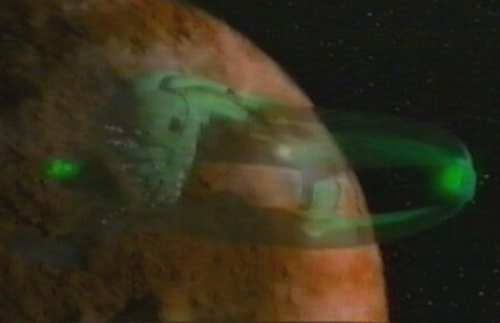
The Romulan Star Empire uses cloaks on its D’deridex-class warbirds. Crews keep tight control over communications and other emissions under cloak. At warp, residual subspace variance can betray a ship’s movement. Misaligned systems can also produce intermittent magnetic distortions.
The Klingon Defence Force uses cloaking devices on ships such as the Bird-of-Prey. Most known cloaks require the vessel to decloak before it can raise shields or fire its weapons. General Chang’s prototype could fire while cloaked. At Khitomer in 2293, the Enterprise-A tracked that ship using its plasma exhaust.
Treaty of Algeron and the USS Defiant
The Treaty of Algeron prohibits Federation development and use of cloaking technology. In 2371, a limited agreement permits the USS Defiant to carry a Romulan cloaking device on loan for operations in the Gamma Quadrant. In exchange, the Federation shares intelligence gathered on those missions with the Romulans. Subcommander T’Rul oversees the device on the first mission.
The USS Ermiana has no cloaking device in its 2371 fit. For the Ermiana’s crew, this technology is primarily a sensor and threat-recognition problem.
Experimental phase cloak
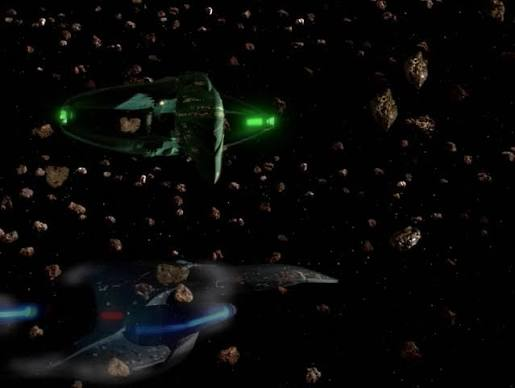
The prototype tested aboard the USS Pegasus in 2358 could also phase a vessel through solid matter. The device failed as the Pegasus passed through an asteroid, leaving part of the ship embedded in the rock. The Enterprise-D recovered the prototype in 2370 and used it to escape the asteroid before decloaking in view of the Romulan warbird Terix.
Detection methods
| Method | What it can reveal | What to report |
|---|---|---|
| Tachyon sweep or grid | A local sweep can probe a suspected contact. A grid of linked emitters covers a wider area, as demonstrated during the Klingon Civil War in 2368. | The sweep or grid sector, when the disturbance crossed it and whether another sensor can corroborate the bearing. |
| Residual emissions | Warp-related subspace variance, intermittent magnetic distortion or plasma exhaust can betray particular ships under the right conditions. | The signature observed, its persistence and the estimated direction of movement. |
| Antiproton scan | Jem’Hadar ships swept the Defiant’s vicinity with antiproton scans on its first Gamma Quadrant mission. The crew reduced power to help the cloak mask the ship’s signature. | The sweep’s proximity and any change in the scanning ships’ behaviour. |
Bridge example
Report the sensor reading first. A bearing on a disturbance gives the bridge something to track. Identification and a weapons lock require better data.
Operations: “Intermittent magnetic distortion. Bearing two-eight-four mark zero-six.”
Tactical: “Same bearing on the second sweep. Possible cloaked contact. I don’t have a lock.”
Command: “Log both readings and keep tracking. Helm, maintain course.”