
STARFLEET TECHNICAL REFERENCE · 2371
Power and Propulsion Systems
USS Ermiana · 2371 · Type 8 matter/antimatter warp drive · Warp 6 cruise · Warp 9.9 maximum · Three impulse engines
Use warp for interstellar travel, impulse for sublight flight, and reaction-control thrusters for precise manoeuvres. The ship distributes power through the Electroplasma System (EPS). A fault in one part of that chain can leave propulsion available while a local service goes dark.
Warp drive
The matter/antimatter reaction assembly, usually called the warp core, produces high-energy plasma. Dilithium regulates the reaction. Power transfer conduits carry plasma from the core toward the nacelles, where the warp coils generate the field used for faster-than-light travel.
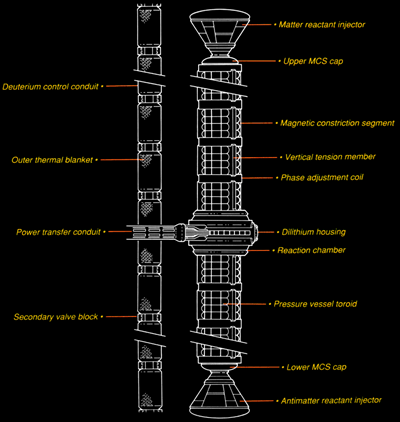
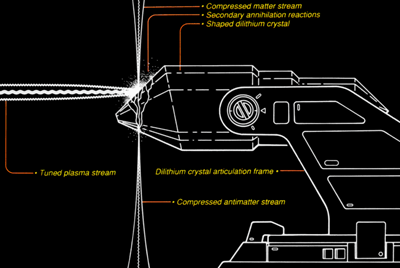
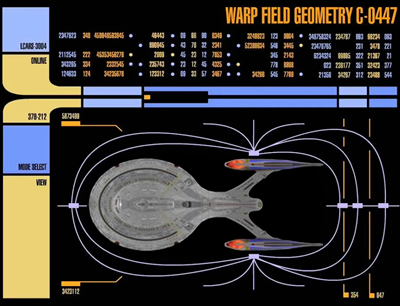
Deuterium and antimatter are stored separately, with magnetic containment used for antimatter. Bussard collectors can gather sparse hydrogen from space to supplement the ship’s matter-side fuel supply. Antimatter reserves and containment remain separate engineering concerns.
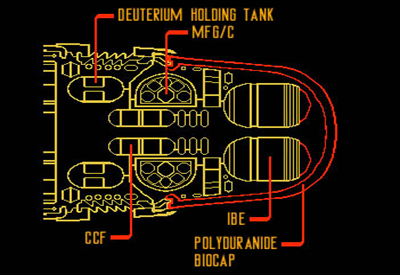
Impulse and reaction-control thrusters
| System | Where it fits in a scene |
|---|---|
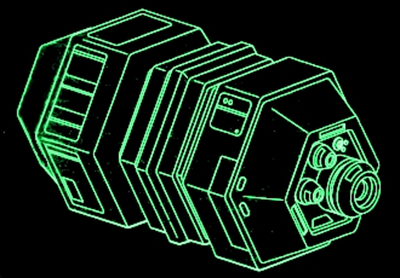
| Impulse engines | Fusion-powered sublight propulsion for departures, orbital flight and approaching a destination. The Ermiana has three impulse engines. Its separated saucer can proceed under impulse power. |
| Reaction control system (RCS) | Precise changes in attitude or position, such as aligning for docking, holding station and clearing another hull during a manoeuvre. |
| Navigational deflector | Clears particles and small debris from the ship’s path. Helm and Engineering can coordinate a speed restriction when deflector coverage is impaired. |
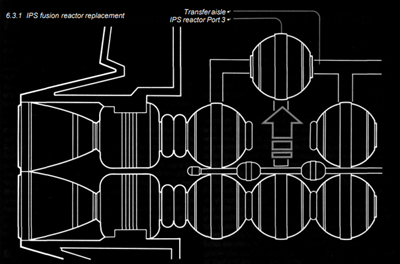
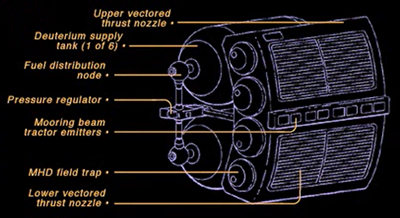
For the division of responsibilities between the saucer and stardrive, see Saucer Separation and Independent Flight.
EPS, auxiliary and emergency power
EPS taps and conduits distribute energy to propulsion support and other ship systems. A fault in a local conduit can interrupt a service while the main plant continues to generate power. Operations can prioritise loads while Engineering isolates the affected branch and verifies an alternate route.
Auxiliary generation can support selected systems when the main supply is reduced. Emergency power supports selected essential services, with priorities set by the situation. During a scene, specify what has power, which services are running in a limited mode, and what must wait for a repair or another source of power.
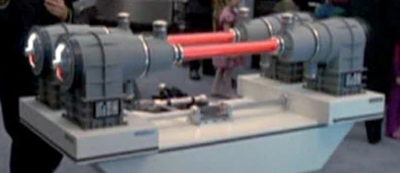
EPS moves power. The Optical Data Network carries data and control traffic. One damaged area can affect both, so an officer should report which service was actually lost.
Ermiana performance in 2371
| Rating | Ship record |
|---|---|
| Cruising speed | Warp 6. |
| Maximum rated speed | Warp 9.9 after the upgrade installed at Utopia Planitia during construction. A sustained duration at this speed has yet to be established in the ship record. |
| Sublight flight | Three impulse engines, with reaction control for fine manoeuvring. |
Warp factors are nonlinear. For a scene, give Flight Control the current route, speed limit and any required stops before quoting an arrival estimate. See the USS Ermiana specifications and Bearings and Navigation.
Engineering reports
Ask what needs a decision. Engineering can report propulsion limits and available power, Ops can name the services affected, and Flight Control can estimate the effect on the route. Give each writer a specific part of the problem to handle.
“Warp drive is available. The port EPS branch has been isolated and the deflector is on its alternate feed. Hold the current speed until we confirm that feed can take the load.”
See the Engineering and Flight Control guides for department duties and Emergency Operations for a propulsion casualty.