
STARFLEET · CLASS TECHNICAL RECORD · 2371
Galaxy Class
Explorer / ship of the line · Federation Starfleet
Flagship multipurpose deep-space explorer with saucer separation, extensive science and diplomatic facilities. A full Ermiana configuration follows below.
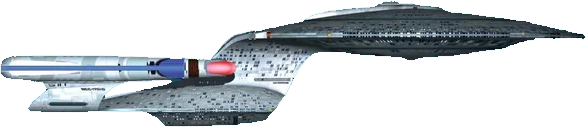
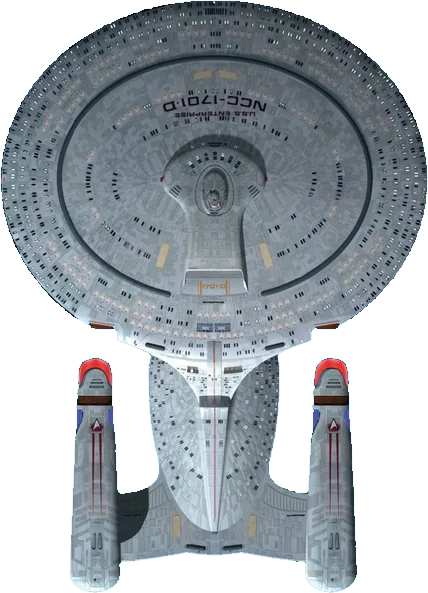
Galaxy-class recognition profile
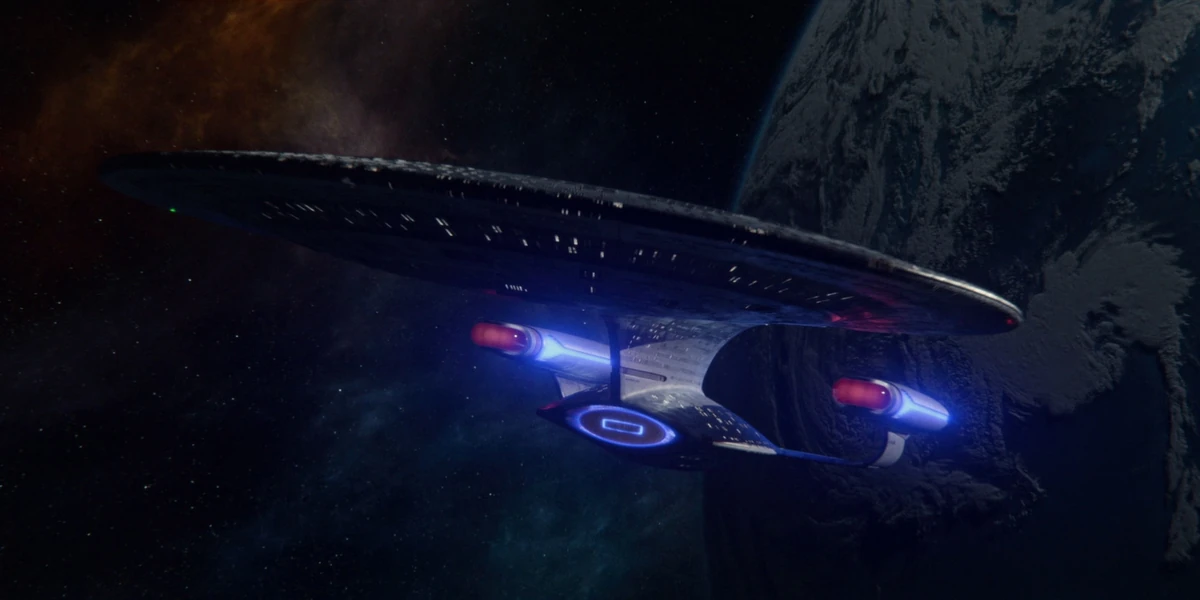
Galaxy-class baseline and USS Ermiana configuration
The data below distinguishes published class-level figures from the vessel-specific specification assigned to USS Ermiana (NCC-74538). Starfleet technical standards permit variation by production block and installed refit. The ship's published dimensions and installations are authoritative for Ermiana, not universal requirements for every Galaxy-class vessel.
| Technical field | Galaxy-class general reference / USS Ermiana published specification |
|---|---|
| Length | 641 metres / 642.5 metres |
| Beam | 473 metres / 463.7 metres |
| Height | 133 metres / 195.3 metres |
| Decks | 42 / 42 |
| Complement | Variable class assignment / 170 officers, 850 enlisted, 200 civilians |
| Emergency capacity | Varies by vessel / 5,000 on USS Ermiana |
| Normal cruise | Warp 6 / warp 6 |
| Maximum standard warp | Warp 9.6 / warp 9.6 in legacy ship figures |
| Emergency warp | Warp 9.8 theoretical / warp 9.8 in legacy ship figures |
| Upgrade | Not universal / warp 9.9 construction-installed refit in USS Ermiana canon |
| Refit interval | Varies by fleet programme / five years on published ship specification |
| Resupply interval | Assignment-dependent / 3–5 years (published) |
Fleet-data reconciliation: The published Ermiana ship specification retains the pre-upgrade warp 9.6/9.8 table even while its narrative states a later warp-core upgrade to warp 9.9. This record preserves both without silently treating them as the same performance condition.
General arrangement and saucer separation
The Galaxy-class design combines a broad primary hull with an independently powered stardrive section. The saucer can separate and operate at impulse speeds; the stardrive hull retains warp propulsion and its own command facilities. Separation is useful during planned civilian evacuation and selected tactical contingencies, but is not a substitute for mission-specific risk assessment.
On Ermiana, the battle bridge occupies the stardrive portion of deck 8. The primary bridge, command ready room and observation lounge occupy deck 1; main engineering is on deck 36. A captain’s yacht is recorded in the saucer section on deck 16.
Structural and mission flexibility
The class is intended for long-duration exploration, diplomacy, scientific survey and humanitarian deployments. Mission-configurable spaces, extensive quarters and specialist laboratories support combined civilian and Starfleet operations. The source vessel's deck directory documents school facilities, childcare, laboratories, arboretum, baths, conference areas and multiple medical complexes.
Propulsion, power and manoeuvring
| Warp power | General Electric Type 8 matter/antimatter reactor assembly; 13 billion gigawatts (ship-published figure) |
|---|---|
| Impulse | Three space-time driver-coil impulse engines: one stardrive, two saucer |
| Reaction control | Magnetohydrodynamic gas-fusion thrusters; source specifies 5.5 million newtons per thruster quad |
| Thruster assist | Small tractor-beam emitters are installed in RCS thruster assemblies |
| Published maximum impulse | 0.75c (ship-published figure) |
| Warp chronology | Original performance references: warp 6 cruise, 9.6 maximum, 9.8 emergency; Ermiana-specific 9.9 upgrade installed during construction |
A legacy speed conversion in the source appears alongside the 0.75c figure and is dimensionally inconsistent. This archive retains 0.75c and does not repeat the incompatible miles-per-hour conversion.
Armament and defensive systems
Phaser arrays provide distributed coverage across primary and secondary hulls. Weapon availability and arcs change when the saucer is detached; the source lists two separate aft torpedo systems plus a saucer-only launcher in the separated configuration.
| Primary hull phasers | Two dorsal Type X arrays; two ventral Type X arrays; one aft Type IX array usable after separation |
|---|---|
| Stardrive phasers | Three ventral Type IX arrays; two dorsal Type IX arrays |
| Nacelle / pylon arrays | Type IX arrays on vertical pylons and nacelle housing, per ship specification |
| Forward torpedo launcher | Stardrive forward fixed-focus photon torpedo / probe launcher |
| Aft torpedo launcher | Stardrive aft fixed-focus photon torpedo / probe launcher |
| Separated saucer launcher | Aft fixed-focus launcher usable only when saucer separates |
| Torpedo inventory | 250 Mark VI photon torpedoes |
| Defence | Deflector shields; structural-integrity and inertial-damping systems |
| Tactical surveillance | 28 independent tracking and identification sensors |
Computers, navigation and communications
| Core computers | Four isolinear computer cores (Ermiana published fit) |
|---|---|
| Operating system | Library Computer Access and Retrieval System (LCARS), version 5.3 |
| Stated processing rate | 500 trillion calculations per second |
| Computer access | Ten graded levels; captain and above at level 10, general read-only level 1 |
| Navigation | Galaxy-class deflector and long-/short-range directional sensor suites |
| Tractor beams | Multiphase subspace graviton emitter; source limit 7.5 million metric tonnes inside 1 km |
| Communications | RF and subspace communications arrays; ship-specific stated radio range 5.2 AU and subspace range 22.65 light-years |
| Transporters | 16 total: six personnel, six cargo, four emergency units |
Scientific and exploration equipment
The published Ermiana specification provides 350 high-resolution sensor pallets, supporting astronomical observation, planetary and life-form analysis, electromagnetic scans, neutrino detection and subspace-field stress assessment. Specialist laboratories span multiple decks and include astrophysics, stellar cartography, geology, chemistry, biomedical research, archaeology, sociology, botany and zoology.
Probe deployment complement
| Class I sensor probe | 25 |
|---|---|
| Class II sensor probe | 25 |
| Class III planetary probe | 20 |
| Class IV stellar encounter probe | 20 |
| Class V reconnaissance probe | 15 |
| Class VI communications relay / emergency beacon | 6 |
| Class VII remote culture study | 12 |
| Class VIII medium-range multimission warp probe | 12 |
| Class IX long-range multimission warp probe | 5 |
Mission-specific loadouts may be modified by Starfleet Command. For probe systems and deployment specifications see Probe Types or the ship equipment annex.
Auxiliary craft and personnel movement
The ship carries three shuttlebays: the main bay on deck 4 and two further bays on deck 13. The published auxiliary complement includes Type 16 shuttlepods, Type 6, 7 and 8 shuttlecraft and Type 9A cargo shuttlecraft, alongside small service craft. An auxiliary survey and logistics role may also be filled by mission-assigned craft.
Personnel transporters are distributed across the vessel; multiple emergency transporter systems support mass-casualty response and evacuation. A captain’s yacht is listed in the deck 16 inventory.
See also Auxiliary Craft Manifest.
USS Ermiana — complete 42-deck reference
This is the Ermiana's assigned deck listing, not a universal plan of every Galaxy-class starship. Changes to internal mission spaces on other vessels are expected. Sections and facility names follow the source directory; grouped terms are abbreviated for quick-reference use.
Main Bridge; Captain’s Ready Room; Aft Observation Lounge; bridge head
Junior officer quarters; executive suites
VIP guest quarters; large conference room; auditorium; weapons storage; executive dining room
Main shuttlebay; shuttle repair unit; cargo bays 1–6; primary communications array; ship stores
Primary/secondary computer systems monitor; computer core access; primary computer core level 1; guest quarters/emergency medical units
Waste reclamation 1; transporter rooms 1–2; guest quarters/emergency medical units; primary computer core level 2
Gymnasium; natatorium; mess hall; galley; crew quarters; conference room 2; primary computer core level 3; chief of security quarters
Saucer: crew quarters; child care centre; school; counsellor’s office and suite; senior command quarters; Japanese bath/spa. Stardrive: battle bridge; equipment storage; stardrive ready room and conference room
Saucer: environmental control 1; attached personnel/colony quarters; emergency supplies; civilian quarters; chief medical officer’s quarters. Stardrive: interim deuterium supply; solid waste reprocessing 1
Saucer: security training; weapons practice range; stores; Ten Forward; saucer impulse engines. Stardrive: weapons storage; secondary communications array
Saucer: primary SIF/IDF generators; holodecks 1–4; attached personnel/colony quarters; saucer impulse engines; cargo bays 7–12. Stardrive: environmental control 2; docking latch manual controls; secondary computer core level 1
Saucer: replicator control; Main Sickbay 1; chief medical officer’s office; medical supplies; gymnasium; biomedical lab; nursery; senior department head and medical staff quarters. Stardrive: Sickbay 2; medical labs 1–2; holographic simulation rooms 1–10; crew quarters; secondary computer core level 2
Saucer: waste reclamation 2; solid waste reprocessing 2; stellar cartography; astrophysics. Stardrive: environmental control 3; shuttlebays 2–3; crew quarters
Saucer: sociology; secondary counsellor’s office; archaeology; chemistry labs 1–2. Stardrive: transporter rooms 3–4; crew quarters
Saucer: particle, geology and biology labs. Stardrive: hazardous-material storage; containment labs 1–2
Saucer: arboretum; captain’s yacht; viewing lounges. Stardrive: plant sciences; botany laboratory
Auxiliary sickbay; zoology laboratory; hydroponics laboratory and gardens
Public and engineering hardware replicators; crew quarters; cargo bays 13–18
Fabrication shop; large conference room; crew quarters
Ship stores; crew quarters
Environmental control 4; crew quarters; transporter rooms 5–6
Helm training; adult classrooms; crew quarters
Main impulse engines; engine control room
Liquid waste reclamation 3; environmental control 5
Forward torpedo launcher; torpedo storage/loading/modification; computer research laboratory
Phaser training range; chief security officer’s office; brig
Deuterium storage tanks; barber shop
Deuterium storage tanks; secondary hardware replicators; auxiliary computer core level 1
Deuterium storage tanks; large meeting room; auxiliary computer core level 2
Auxiliary computer monitor/access; auxiliary computer core level 3; deuterium injectors
Engineering parts/equipment storage; turbolift control and repair
Secondary SIF generators; astrometrics; materials testing
Holographic simulation rooms 11–20; attached personnel/colony quarters; secondary IDF generators
Solid waste reprocessing 3; secondary replicator control; environmental control 6
Main engineering upper access; aft torpedo launcher and stores; attached personnel/colony quarters
Main engineering; chief engineer’s office; engineering laboratories
Main engineering lower access; sensor analysis labs; sensor instrument bays; emergency food stores
Cargo bay 3; emergency personnel transporter 1; hazardous-material storage and containment
Cargo bay 4; emergency personnel transporter 2; emergency power facility
Backup antimatter pod storage; emergency personnel transporter 3; antimatter injectors
Antimatter storage pods; antimatter generator
Antimatter fill port; tractor beam emitter; warp core ejection hatch
Operational service through 2371
Known vessels or service examples: USS Galaxy; USS Enterprise-D; USS Odyssey; USS Yamato.
Flagship multipurpose deep-space explorer with saucer separation, extensive science and diplomatic facilities. A full Ermiana configuration follows below.
This record is restricted to knowledge available by 2371. Later operations, class modifications, successor programmes and ships commissioned after the archive date are not included.