
STARFLEET SCIENCE & OPERATIONS / TECHNICAL REFERENCE · 2371
Starfleet Probe Classes
Technical reference and operating profiles for Class 1–9 sensor and long-range probes
Overview
Starfleet employs specialised unmanned probes for stellar observation, planetary surveys, reconnaissance, communications, cultural monitoring and high-warp missions.
This reference records the nine probe classes listed in the original USS Ermiana archive, including the Class 2 variant. Every illustration has been retained in its original sequence and stored locally. Specifications below follow the source archive, including its terminology and numerical values.
Find a probe class
Search for a class number, mission type, capability, range or sensor system, or select a record below.
Showing 9 probe classes
Technical specifications
The displayed artwork is reproduced from the supplied reference images, not redrawn. Dimensions are illustrative; technical ranges are shown exactly as recorded.
Class 1
Basic Stellar Phenomenon Sensor Probe
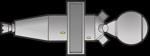
- Function
- Basic Stellar Phenomenon Sensor Probe
- Range
- 200,000 km
- Speed
- >0.5c
- Engine
- Vectored deuterium micro-fusion propulsion
- Sensors
- Full EM/Subspace and interstellar chemistry pallet for in-space applications.
- Telemetry
- 12,500 channels at 12 Megawatts.
Class 2 & 2 Variant
Enhanced Stellar Phenomenon Sensor Probe
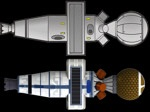
- Function
- Enhanced Stellar Phenomenon Sensor Probe
- Range
- 400,000 km
- Speed
- 0.65c
- Engine
- Vectored deuterium micro-fusion propulsion, with extended deuterium fuel supply.
- Sensors
- Full EM/Subspace and interstellar chemistry pallet for in-space applications. Enhanced long-range particle and field detectors and imaging system.
- Telemetry
- 15,650 channels at 20 Megawatts.
Class 3
Planetary Sensor Probe
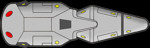
- Function
- Planetary Sensor Probe
- Range
- 1,200,000 km
- Speed
- 0.65c
- Engine
- Vectored deuterium micro-fusion propulsion.
- Sensors
- Terrestrial and gas giant sensor pallet with material sample and return capability, and an on-board chemical analysis sub-module. Limited SIF hull reinforcement. Full range of terrestrial soft landing to subsurface penetration missions. Gas giant atmosphere missions survivable to 450 bar pressure. Limited terrestrial loiter time.
- Telemetry
- 13,250 channels at approximately 15 Megawatts.
Class 4
Stellar Encounter Probe
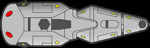
- Function
- Stellar Encounter Probe
- Range
- 3,500,000 km
- Speed
- 0.60c
- Engine
- Vectored deuterium micro-fusion propulsion supplemented with continuum driver coil, and an extended maneuvering deuterium supply.
- Sensors
- Triply redundant stellar fields and particles detectors, stellar atmosphere analysis suite. Six ejectable and survivable radiation flux sub-probes. Deployable for non-stellar energy phenomena.
- Telemetry
- 9,780 channels at 65 Megawatts.
Class 5
Reconnaissance Probe
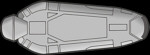
- Function
- Reconnaissance Probe
- Range
- 43,000,000,000 km
- Speed
- Warp 2
- Engine
- Dual-mode matter / antimatter engine. Extended duration at sub-light, and limited duration at warp.
- Sensors
- Extended passive data-gathering and recording systems, with full autonomous mission execution and return system. Planetary atmosphere entry and soft landing capability. Low observability coatings and hull materials. Can be modified for tactical applications with addition of custom sensor countermeasure package.
- Telemetry
- 6,320 channels at 2.5 Megawatts.
Class 6
Long Range Probe, Comm. Relay, Emergency Beacon
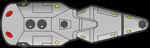
- Function
- Long Range Probe, Comm. Relay, Emergency Beacon
- Range
- 43,000,000,000 km
- Speed
- 0.8c
- Engine
- Microfusion engine with high output MHD power tap.
- Sensors
- Standard pallet. Extended deuterium supply for transceiver power generation and planetary orbit plane changes.
- Telemetry
- 9,270 channel RF and subspace transceiver operation at 350 Megawatts peak radiated power. 360 omni antenna coverage, 0.0001 arc-second high-gain antenna pointing resolution.
Class 7
Remote Cultural Study Probe
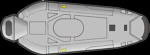
- Function
- Remote Cultural Study Probe
- Range
- 450,000,000 km
- Speed
- Warp 1.5
- Engine
- Dual-mode matter / antimatter engine.
- Sensors
- Passive data gathering system plus subspace transceiver. Applicable to civilizations up to technology level III. Low observability coatings and hull materials. Maximum loiter time: 3,5 months. Low-impact molecular destruct package tied to anti-tamper detectors.
- Telemetry
- 1.050 channels at 0.5 Megawatts.
Class 8
Warp Capable Probe
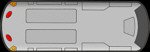
- Function
- Warp Capable Probe
- Range
- 120 light years
- Speed
- Warp 9
- Engine
- Matter / antimatter warp field sustainer engine. Duration 6.5 hours at warp 9. MHD power supply tap for sensors and subspace transceiver.
- Sensors
- Standard pallet plus mission-specific modules. Applications vary from galactic particles and fields research to early-warning reconnaissance missions.
- Telemetry
- 4,550 channels at 300 Megawatts.
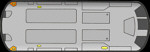
Class 9
Long Range Warp Probe
- Function
- Long Range Warp Probe
- Range
- 760 light years
- Speed
- Warp 9
- Engine
- Matter / antimatter warp field sustainer engine. Duration 12 hours at warp 9. Extended fuel supply for Warp 8 maximum flight duration of fourteen days.
- Sensors
- Standard pallet plus mission-specific modules. Limited payload capacity. Isolinear memory storage of 3,400 kiloquads. Fifty-channel transponder echo. Typical application is emergency log-message capsule on homing trajectory to nearest starbase or known Starfleet vessel position.
- Telemetry
- 6,500 channels at 230 Megawatts.