
STARFLEET SCIENCE / ASTRONOMICAL REFERENCE · 2371
Nebula Classifications
Interstellar gas, dust and plasma phenomena — astronomical and Starfleet operational reference
Overview
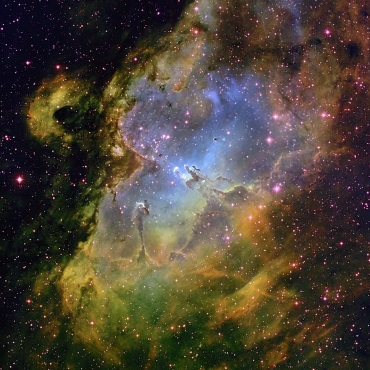
Nebulae are interstellar clouds of gas, dust and other material. Some are regions of active star formation; others arise from the evolution or destruction of stars.
This reference follows the classification system published in the USS Ermiana archive, including Star Trek-specific phenomena such as inversion, dark matter and Mutara nebulae. Scientific and fictional entries are presented within that established RPG system rather than silently reclassified.
The original introduction mentions four broad categories, but its actual article headings list three: Emission, Non-Emission and Disruptive. This page follows those three published groups.
Find a nebula class
Search by classification, phenomenon, chemical composition, size, example or associated hazard.
Showing 23 of 23 classes
Classification records
Data values are reproduced from the older Ermiana reference where supplied. Empty specifications in the source are omitted rather than estimated.
H II Region
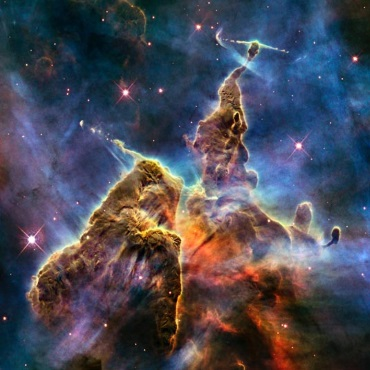
A large stellar nursery, often inside an emission nebula, capable of giving birth to thousands of stars. Powerful young stars ultimately disperse surrounding gas and leave a star cluster.
- Composition
- Hydrogen, helium, oxygen, ionized gases or plasma; other elements may be present
- Average size
- 20–5,000+ ly
- Average temperature
- 10–20 K
- Average lifespan
- 1–5+ million years
- Examples
- Eagle Nebula; Orion Nebula; NGC 604
Evaporating Gas Globule
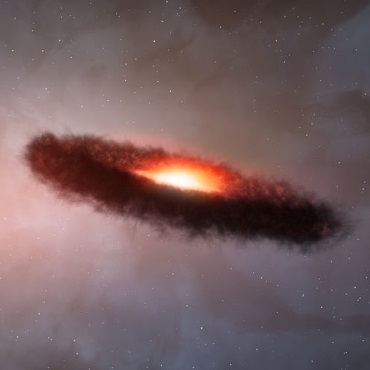
A hydrogen-gas concentration around 100 astronomical units across. It shields material behind it from ionizing ultraviolet radiation, allowing dense sheltered regions to develop into sites of star formation.
- Examples
- Pillars of Creation (H II regions)
Molecular Cloud
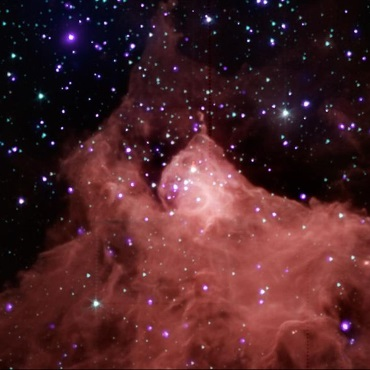
An interstellar cloud dense and extensive enough for molecules to form, particularly molecular hydrogen. Some molecular clouds act as stellar nurseries.
- Examples
- Circinus Cloud; Barnard 68; Cepheus B
Bok Globule
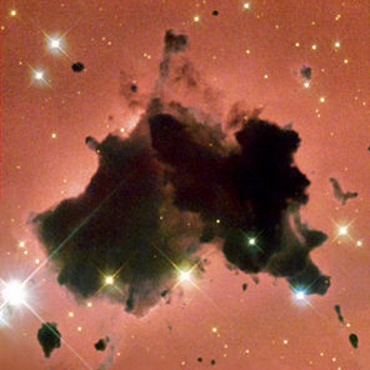
Compact and dense gas-and-dust concentrations, often within H II regions, where stars form; the old record particularly associates them with binary and trinary systems.
- Composition
- Molecular hydrogen, carbon oxides, helium, silicate dust
- Average size
- 100 AU–1 ly
- Average temperature
- 3 K
- Average lifespan
- 1–2 million years
- Examples
- Thackeray’s Globules; The Caterpillar
Solar / Protostellar Nebula
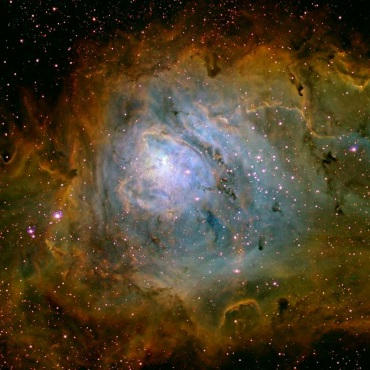
Material drawn around a forming star can flatten into a disk of gas and dust that develops into a system containing planets and asteroids.
- Composition
- Hydrogen, helium, oxygen, ionized gases or plasma, with variable heavier elements
- Average size
- 0.75 ly
- Average temperature
- 150 K
- Average lifespan
- 2 million years
- Examples
- McAllister C-5 Nebula
Wolf–Rayet Nebula
A nebulous halo created as powerful stellar winds strip matter from a massive star.
- Composition
- Hydrogen
- Average size
- 0.5+ ly
- Average temperature
- 30,000–200,000 K
- Average lifespan
- 1–2 million years
- Examples
- NGC 6888; NGC 2359
Protoplanetary Nebula

A short-lived transitional stage between the asymptotic giant branch and planetary-nebula phases of an evolving star. This type of nebula radiates strongly in infrared and can show reflective and emissive characteristics.
- Composition
- Hydrogen, helium, carbon, nitrogen, oxygen, neon
- Average size
- 0.5 ly
- Average temperature
- 5,000 K
- Average lifespan
- 5,000–10,000 years
- Examples
- Westbrook Nebula; IRAS 20068+4051
Planetary Nebula
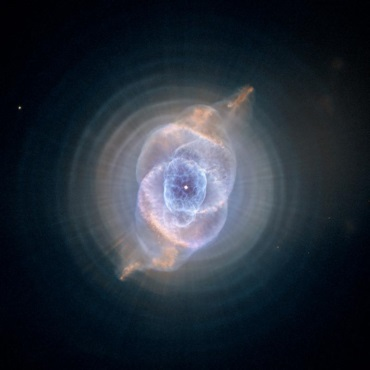
Despite its name, it is not a planet-forming cloud. It is an expanding shell of ionized material shed by a dying red giant; radiation from the exposed stellar core illuminates the expelled gas.
- Composition
- Hydrogen, helium, carbon, nitrogen, oxygen, neon
- Average size
- 1 ly
- Average temperature
- 10,000–25,000 K
- Average lifespan
- 10,000 years
- Examples
- Cat’s Eye Nebula; Ring Nebula; Helix Nebula
Bipolar Nebula
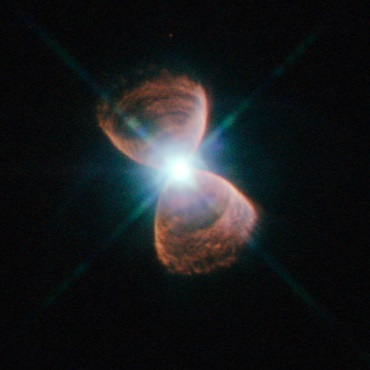
A nebula with a broadly axisymmetric, two-lobed structure. Some planetary nebulae exhibit this geometry, and the source notes a possible evolutionary connection.
- Examples
- PN Hb 12; Eta Carinae
Nova Remnant
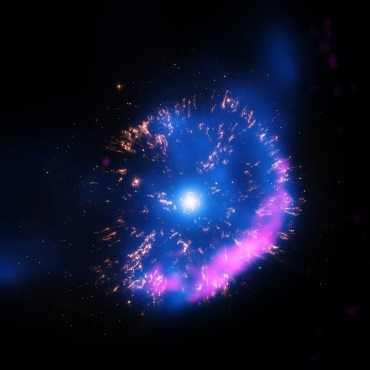
Material left by a nova explosion or the gas bubbles blown away during repeated nova outbursts.
- Composition
- Mostly hydrogen, helium, carbon, neon, oxygen, silicon, iron and ionized plasma; heavier elements possible
- Average size
- 0.5 ly
- Average temperature
- 5,000–10,000 K
- Average lifespan
- 100–300 years
- Examples
- GK Persei; T Pyxidis
Supernova Remnant
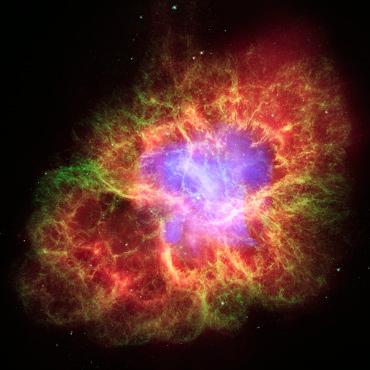
An expanding structure of stellar ejecta and swept-up interstellar matter bounded by the shock wave from a supernova explosion.
- Composition
- Hydrogen, helium, carbon, neon, oxygen, silicon, iron, ionized plasma and other possible elements
- Average size
- 3 ly
- Average temperature
- 10,000,000 K
- Average lifespan
- 1 million years
- Examples
- SN 1987A; Cygnus Loop; Crab Nebula
Superbubble / Supershell Nebula
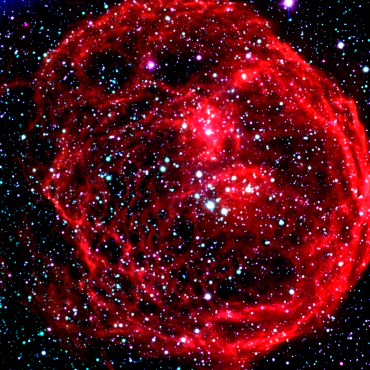
A vast cavity produced by multiple supernovae and strong stellar winds, often hundreds of light-years across. Large superbubbles can reach beyond the galactic disk.
- Examples
- Henize 70; Orion–Eridanus; LHA 120-N 44
Inversion Nebula
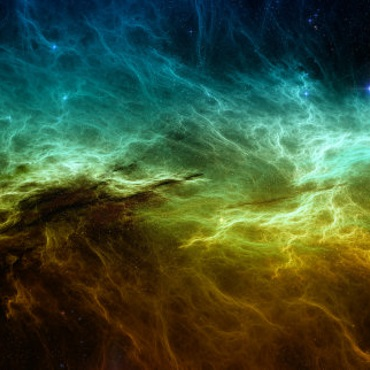
A rare, highly unstable plasma-string phenomenon described in the Ermiana archive; the source mentions an artificially sustained example in the Delta Quadrant.
- Composition
- Ionized plasma strings
- Average size
- 100–200 AU
- Average temperature
- 10,000 K
- Average lifespan
- 5–10 years
- Examples
- Marayna Nebula (Delta Quadrant)
Reflective Nebula
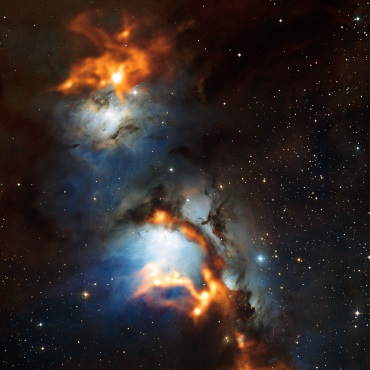
Interstellar dust illuminated by nearby stars scatters their light without substantial gas ionization. Its spectrum resembles that of the illuminating stars, and scattered light can be polarized.
- Composition
- Hydrogen, helium and micrometre-sized dust particles coated with frozen carbon monoxide and nitrogen
- Average size
- 100 ly
- Average temperature
- 25,000 K
- Average lifespan
- 10 million–10 billion years
- Examples
- Witch Head Nebula; Homunculus Nebula; Messier 78
Dark Nebula
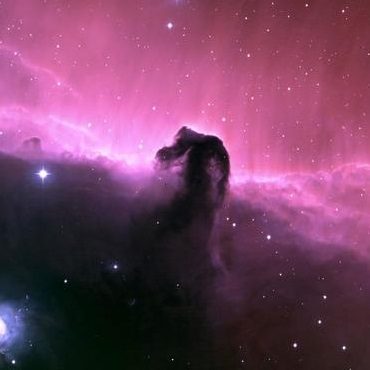
Dense interstellar material that obscures background stars and bright nebulae. Radio and infrared observations can penetrate regions that are opaque in visible light.
- Composition
- Hydrogen, carbon, iron, nickel
- Average size
- 100–300 ly
- Average temperature
- 7 K
- Average lifespan
- 1–2 million years
- Examples
- Lupus 4; Horsehead Nebula; Cone Nebula
Giant Molecular Cloud
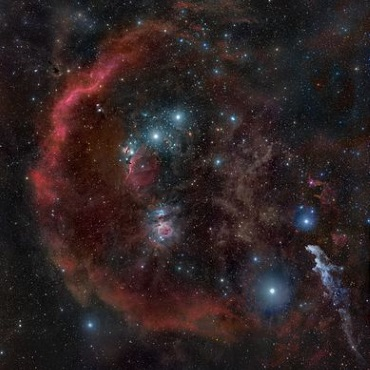
A very large and relatively dense cloud of molecular gas with complex filaments, sheets, bubbles and clumps. Its huge volume gives it a large total mass.
- Composition
- Particulate matter, hydrogen, helium, and trace molecules such as carbon monoxide or ammonia
- Average size
- 15–600 ly
- Examples
- Orion and Taurus Molecular Clouds; Sagittarius B2
Black Cluster
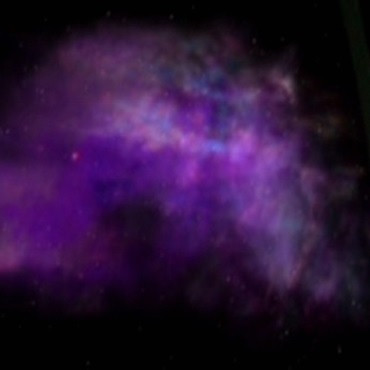
A dangerous cluster formed by the collapse of many nearby protostars. The resulting region absorbs energy and may interfere severely with spacecraft sensors and systems, according to the Star Trek in-universe record.
- Examples
- Near Starbase 514; Deep Space 3; Breen space
Intergalactic Gas / Warm–Hot Intergalactic Medium
Diffuse plasma between galaxies. The source describes temperatures of roughly 10⁵–10⁷ K and observation principally through ultraviolet or low-energy X-ray absorption or emission.
- Average temperature
- 10⁵–10⁷ K
- Examples
- Intergalactic medium; not directly visible
Dark Matter Nebula
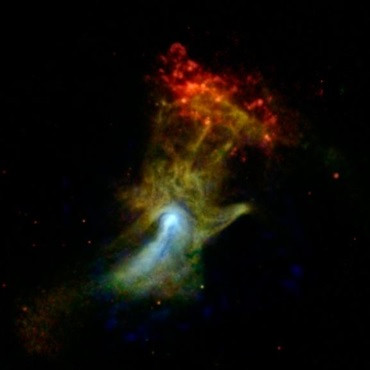
An unusually hard-to-detect accumulation in which sufficiently concentrated exotic material may produce phasing effects in normal matter, according to the in-universe description.
- Examples
- Robinson; Mar Oscura
Pulsar Wind Nebula
A nebula supplied with energetic particles by a pulsar’s rapidly rotating magnetic field. The relativistic particle wind collides with surrounding interstellar material, forming a shock.
- Examples
- Crab; Vela; Hand of God Nebula
Mutara Nebula
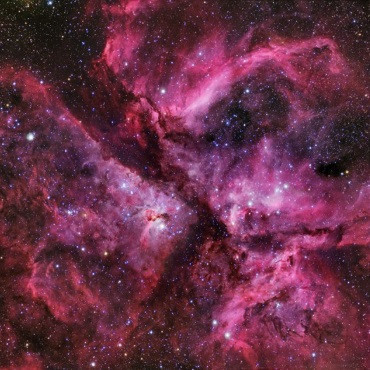
A nebula containing high concentrations of ionized gases and electrical discharges; the in-universe description states that it disrupts starship shields and sensors.
- Examples
- Mutara; Charma Vortex; Paulson Nebula
Swallow Nebula
An especially hazardous subtype of Mutara nebula, containing subnucleonic radiation capable of damaging technology and organic tissue.
- Examples
- Swallow Nebula (Delta Quadrant)
Dichromatic Nebula
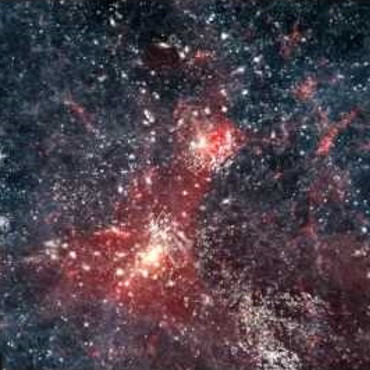
Interstellar gas clouds characterised by intense gravimetric distortions in the source’s Star Trek classification scheme.
- Examples
- Dorias Cluster